
Google Sheets vs Wedding Budget App: Which Is Better for Kenyan Couples?
Google Sheets is free and flexible. A wedding budget app does the math for you. Here's an honest breakdown of which works better and when.
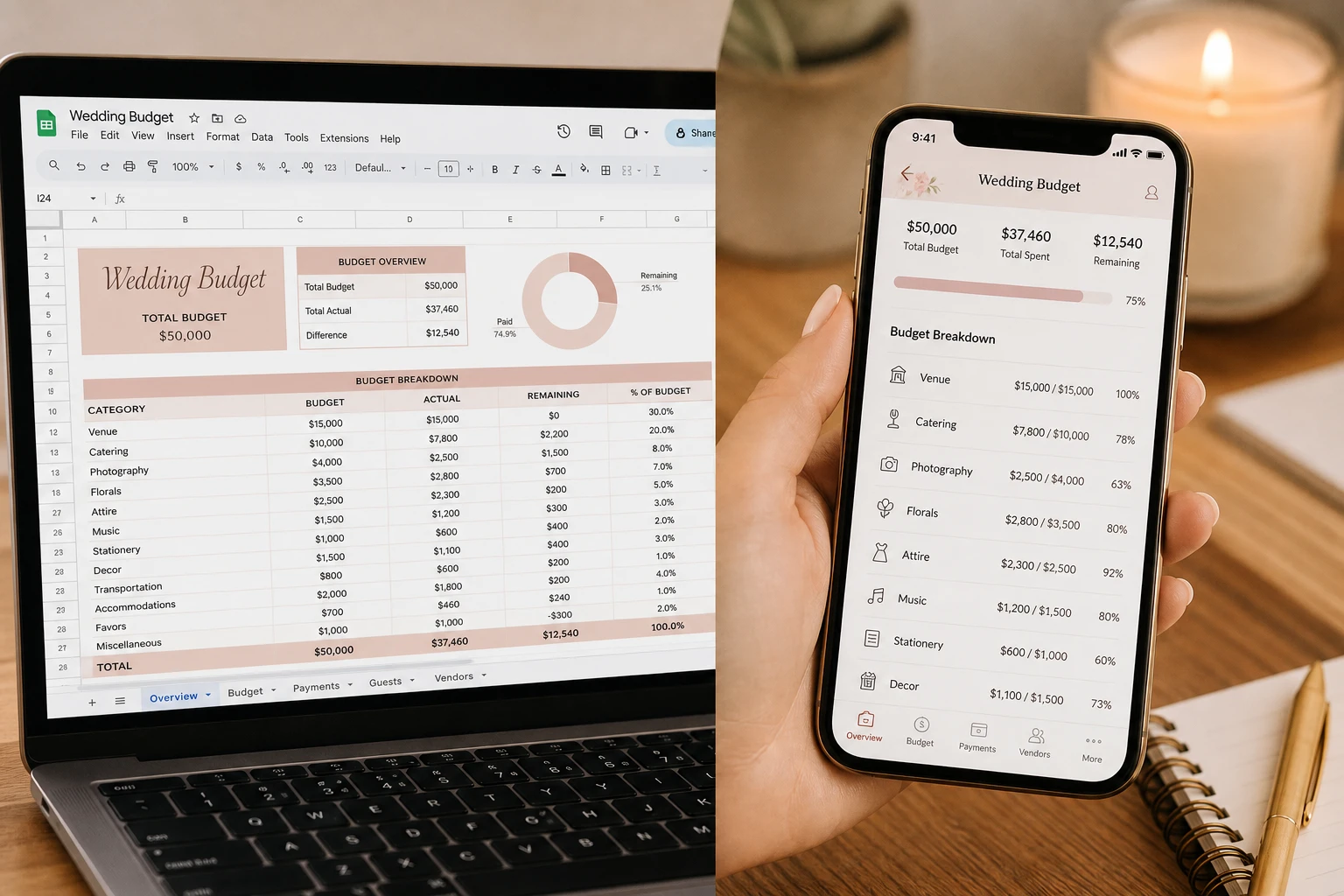
Most couples start their wedding budget in Google Sheets. It makes sense — it is free, you already know how to use it, and you can structure it however you want. Three months in, many of those couples are maintaining something that has grown beyond what they expected: a spreadsheet with 200 rows, multiple formula columns that break when you update adjacent cells, and no clean way to track which payments have been made versus which are still outstanding.
Here is an honest breakdown of when Google Sheets is the right tool and when a dedicated budget app starts to earn its keep.
What Google Sheets Does Well
Full flexibility. You design the structure. If you want to track costs by vendor, by event, by payment method, or by who made the payment, you can build that. No app will give you the same configurability.
Collaborative editing. Share with your partner, your parents, your wedding coordinator. Everyone can view and edit. No app accounts needed.
Free. Forever, with no feature limits tied to a paywall.
Familiar. If you have ever managed a budget before, you already know the basics of what you are doing.
Exportable. Your data is yours in a format that opens anywhere.
For straightforward budgets — under KES 500,000, one event, fewer than 15 distinct vendor categories — Google Sheets is often sufficient.
Where Google Sheets Creates Problems
No automatic payment tracking. When you pay a deposit to a caterer, you manually update the row. When you pay the balance, you manually update again. When you want to know the total you have paid versus total outstanding, you write a SUM formula over multiple columns. This is manageable but error-prone, especially when updates happen on mobile.
Multi-event complexity. If your wedding involves a ruracio, a traditional ceremony, and a church wedding — each with separate vendor costs — organizing them in a single sheet requires significant discipline. Most couples end up with multiple tabs, cross-references, and eventual confusion about which totals include which events.
No M-Pesa payment record. When you pay via M-Pesa, you get a text confirmation. Linking that to your spreadsheet requires manual entry. There is no integration that pulls M-Pesa transactions into a spreadsheet automatically.
Category totals without context. Sheets can show you "KES 180,000 spent on catering" but it cannot easily show you "KES 80,000 paid to Caterer A (deposit), KES 50,000 paid to Caterer B (full payment), KES 50,000 still owed to Caterer A." That level of detail requires careful structuring that most people do not maintain consistently.
No mobile-first experience. Editing a complex spreadsheet on a mobile phone is painful. Most budget updates happen on mobile — you paid a vendor, you are away from your laptop, and the Google Sheets mobile app is not designed for comfortable data entry.
What a Wedding Budget App Does Better
A dedicated wedding budget app — like Harusi Hub's built-in budget tool — trades flexibility for structure. The structure gives you things a spreadsheet cannot.
Pre-built categories. A good wedding budget app comes with the categories that matter for Kenyan weddings: venue, catering, photography, attire, flowers, entertainment, traditional ceremony costs, transport, beauty. You are not building the structure — you are filling it in.
Payment tracking per vendor. Each vendor entry tracks the total agreed cost, deposits paid, balance remaining, and payment method (M-Pesa, bank transfer, cash). You see at a glance which vendors are fully paid and which have outstanding balances.
Budget vs actual comparison. As you add actual payments, the app shows you where you are over budget (venue, typically) and where you have headroom. In a spreadsheet, this comparison requires formula work. In an app, it updates automatically.
Mobile-first. Adding a payment record on your phone is fast. The form is designed for it.
Shared with partner. Both of you see the same real-time picture. No version conflicts, no "did you update the sheet?" conversations.
For a look at Harusi Hub's budget tool specifically, see wedding budget tracker free tool.
The Kenyan Budget Context
Two things make Kenyan wedding budgets specifically challenging for a generic spreadsheet:
M-Pesa payments are the norm. Most vendor payments happen via M-Pesa — deposits, partial payments, balances. Tracking these in a spreadsheet is straightforward but requires discipline. An app that is designed to log payment method alongside amount and vendor makes this easier to maintain accurately.
Multi-event cost structure. A ruracio has separate costs from a church wedding. Traditional ceremony décor is separate from reception décor. Catering for 80 people at the traditional ceremony is different from catering for 300 at the reception. Organizing these in a spreadsheet requires explicit structure. A budget app designed for multi-event Kenyan weddings has that structure built in.
See wedding budget guide Kenya for a full breakdown of typical costs by category.
A Realistic Recommendation
Use Google Sheets if:
- Your budget is relatively simple (one main event, under KES 400,000, fewer than 10 vendors)
- You or your partner are comfortable with spreadsheet formulas
- You want maximum flexibility and do not mind maintaining the structure yourself
Use a dedicated budget app if:
- Your wedding involves multiple events with separate cost centers
- You are making frequent M-Pesa payments to multiple vendors and want clear records
- You want a mobile-friendly way to add payments on the go
- You want automatic budget vs actual comparisons without building formulas
Use both if:
- Start in Google Sheets for early brainstorming and rough estimates
- Move to Harusi Hub's budget tool once vendors are confirmed and payments begin
Many couples find a hybrid works well: Sheets for initial planning, an app for active payment tracking once contracts are signed. The structured payment tracking a dedicated app provides is most valuable during the final six months when deposits and balances are being paid.
The Bottom Line
Google Sheets is not the wrong tool. It is a flexible, free, collaborative tool that many Kenyan couples use successfully for wedding budget management. Its limitations show up at scale: larger guest lists, multiple ceremonies, many vendors, frequent payments.
A dedicated wedding budget app trades flexibility for structure — and that structure becomes more valuable as your wedding gets more complex. If you are managing a multi-event Kenyan wedding with payments flowing across M-Pesa, bank transfer, and cash to a dozen vendors, structured tracking pays for itself in time saved and errors avoided.
Know exactly where every shilling is going
Track vendor payments, deposits, and balances in a tool built for Kenyan weddings. Free to start.
Start Your Free Wedding Budget