
Intercultural Weddings in Kenya: Navigating Two Families with Different Customs
Marrying across Kenyan cultural lines? Here's how to navigate the expectations, rituals, and family dynamics of an intercultural wedding without losing yourself.
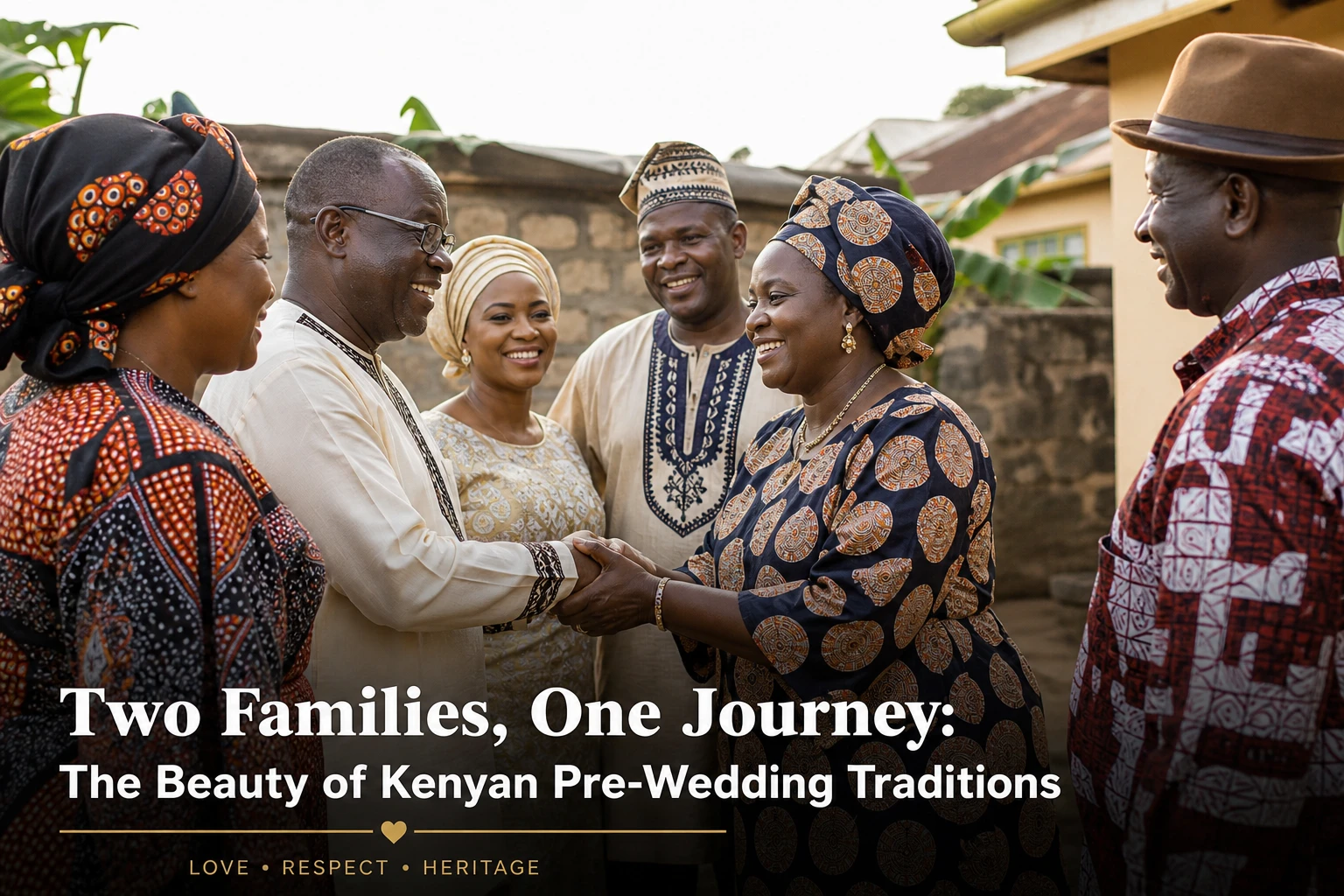
You knew your families were different. You didn't fully know what that would mean when planning a wedding.
Kenya is a country of more than forty ethnic groups, each with its own wedding traditions, expectations around dowry and negotiation, distinct ceremony structures, and particular meanings attached to food, dress, and timing. When two people from different communities fall in love and decide to marry, the wedding becomes an event that must serve two families who may have very different ideas about what a proper wedding looks like.
This is not a problem to be solved. It is a situation to be navigated — with respect, creativity, and frank conversation. Couples who do it well often say their intercultural wedding was the most meaningful event of their lives precisely because of the care it required.
The First Thing to Understand
Before logistics, before venues, before catering — understand this: neither family is wrong.
Your mother-in-law who insists on a full ruracio before any wedding planning begins is not being difficult. She is upholding a practice that has defined family, respect, and belonging in her community for generations. Your father who expects a church wedding with a choir and a reception that goes until midnight is not being unreasonable. He is expressing what he believes a wedding is.
When you approach both families from this posture — their expectations are legitimate, even when they conflict with yours — the conversations become easier. You're not fighting ignorance. You're negotiating between equally valid traditions.
Common Intercultural Pairings in Kenya and Their Pressure Points
Kikuyu-Luo
Two of Kenya's largest communities, with strong and distinct wedding cultures. The ruracio (Kikuyu dowry negotiation) is a formal, often elaborate event involving extended family representatives on both sides. Luo dowry customs — cholla, involving cattle and formal negotiations — are equally structured. When both families expect their own process to be honored, the couple must navigate who goes first, where, and how each family's ceremony is represented.
Kikuyu and Luo church traditions also differ. Kikuyu weddings often have a strong PCEA or Catholic presence; Luo weddings may be in Anglican, Catholic, or Seventh-Day Adventist churches.
Swahili-Upcountry
Swahili weddings on the coast are among the most ceremonially rich in Kenya — the nikkah, the bridal preparation, the reception (arusi) with taarab music, and specific gender-separated traditions. When a Swahili family meets an upcountry family from, say, the Mt. Kenya region, the contrasts can be stark: in dress, in music, in what "hospitality" looks like, in the pace of the day.
Indian-Kenyan and African-Kenyan
With the Indian-Kenyan community now several generations deep in Kenya, these pairings are no longer unusual. The Hindu vivah, the Sikh Anand Karaj, or Muslim nikah meets the dowry practices of a Kenyan community — requiring families to learn each other's languages of respect quickly. Our guide to Indian Kenyan wedding traditions covers what families typically expect.
Practical Framework: Three Conversations to Have Early
Conversation 1: What Is Non-Negotiable for Each Family
Sit with each set of parents separately (and, if possible, together) and ask them directly: What must happen at this wedding for you to feel your family has been honored?
You will get answers that surprise you. Some things you assumed were mandatory are actually flexible. Some things you assumed were optional are deeply important. This conversation is worth more than any amount of research.
Write down what each family identifies as non-negotiable. Then look at the list together with your partner. Usually, the non-negotiables are fewer and more specific than you feared.
Conversation 2: Who Goes First
In most Kenyan cultures, the traditional ceremonies — dowry negotiations, bride wealth, family introductions — happen before the wedding. But when two families have separate traditional processes, the question of sequence matters.
A common approach: hold each family's traditional ceremony at their respective homestead, in their own sequence, before the main wedding. The groom's family visits the bride's family for the dowry process (regardless of which tradition governs it). Each family feels that their customs were respected in their own space.
Conversation 3: The Wedding Day Itself
The main wedding — whether church, civil, or both — belongs to the couple. But the reception is where family culture expresses itself most visibly: in the food, the music, the speeches, the order of events.
Decide in advance: will you have a single unified reception that blends both cultures, or will there be distinct moments that belong to each side? Some couples do a brief cultural presentation from each family during the reception — a song, a dance, a traditional blessing — before moving into a shared programme. This creates a natural "meeting point" without forcing a merger of everything.
On Dowry and Bride Wealth
Across communities, the practice of bride wealth or dowry — whatever name it goes by — is a significant moment of family negotiation. It is not a transaction; it is a ritual of respect, acknowledgment, and relationship-building between families.
When two different communities each have their own bride wealth customs, the couple (and their immediate families) must decide: do we honor both processes, or do we adopt one?
There is no universally right answer. Some couples honor both: a ruracio and a cholla, conducted sequentially. Others adopt the bride's family's custom as the primary process since it is her hand being given. Others negotiate a hybrid that both families understand and accept.
What matters is transparency. Don't let one family discover mid-planning that you've decided their tradition isn't being included. That breeds resentment that outlasts the wedding.
For context on specific Kenyan wedding traditions and what different communities expect, see our guides on Kenyan wedding traditions and Kikuyu ruracio traditions.
Catering the Intercultural Reception
Food is how Kenyan families express love and hospitality. Getting it wrong — or being seen to favor one family's cuisine — is noticed.
The safest approach is abundance and representation. Work with your caterer to include signature dishes from both communities. If one family's tradition calls for nyama choma and ugali and the other expects pilau and biriani, find a caterer who can do both well. Don't compromise quality in either direction.
Similarly, be thoughtful about dietary restrictions that may follow religious lines. Coastal Muslim guests expect halal meat. Hindu guests may be vegetarian. Plan for this rather than being surprised on the day.
Dress: Honoring Both Aesthetics
Some couples wear two outfits on their wedding day — one reflecting each family's tradition. The bride might wear a kikoi and kanga for the traditional ceremony and a gown or sari for the church and reception. The groom might wear a kanzu and kofia for one event and a suit for another.
Others find a single outfit that weaves both aesthetics — a gown in the colors of one family's tradition, with accessories from the other. There is no formula. What matters is that the choice is intentional and explained — to yourselves first, then to your families.
When Families Clash Directly
Sometimes, despite your best efforts, family members on one side say something dismissive about the other family's traditions. Or a relative refuses to attend a ceremony from the other culture. These moments are painful, and they are more common than most couples admit.
A few principles:
- Don't let your partner fight your family alone. If a guest on your side behaves badly toward your partner's family, it is your responsibility to address it — not your partner's.
- Protect the day by preparing for conflict in advance. Identify the people most likely to create tension. Have a trusted family member or MC who can redirect gracefully.
- Give grace where you can. Some relatives need time. A wedding does not resolve decades of cultural distance. What it can do is begin a relationship.
As we say: harusi ni mwanzo, si mwisho — the wedding is the beginning, not the end.
All your ceremonies, one place for guests to find them
Add every event — traditional ceremony, church service, reception — to your Harusi Hub wedding website so both families always know where to be.
Create Your Free Wedding Website