
Why Your Wedding Needs a Website, Not a WhatsApp Broadcast List
A WhatsApp broadcast list gets information out fast. A wedding website keeps it organized and findable forever. Here's why you need both — and what each one is actually for.
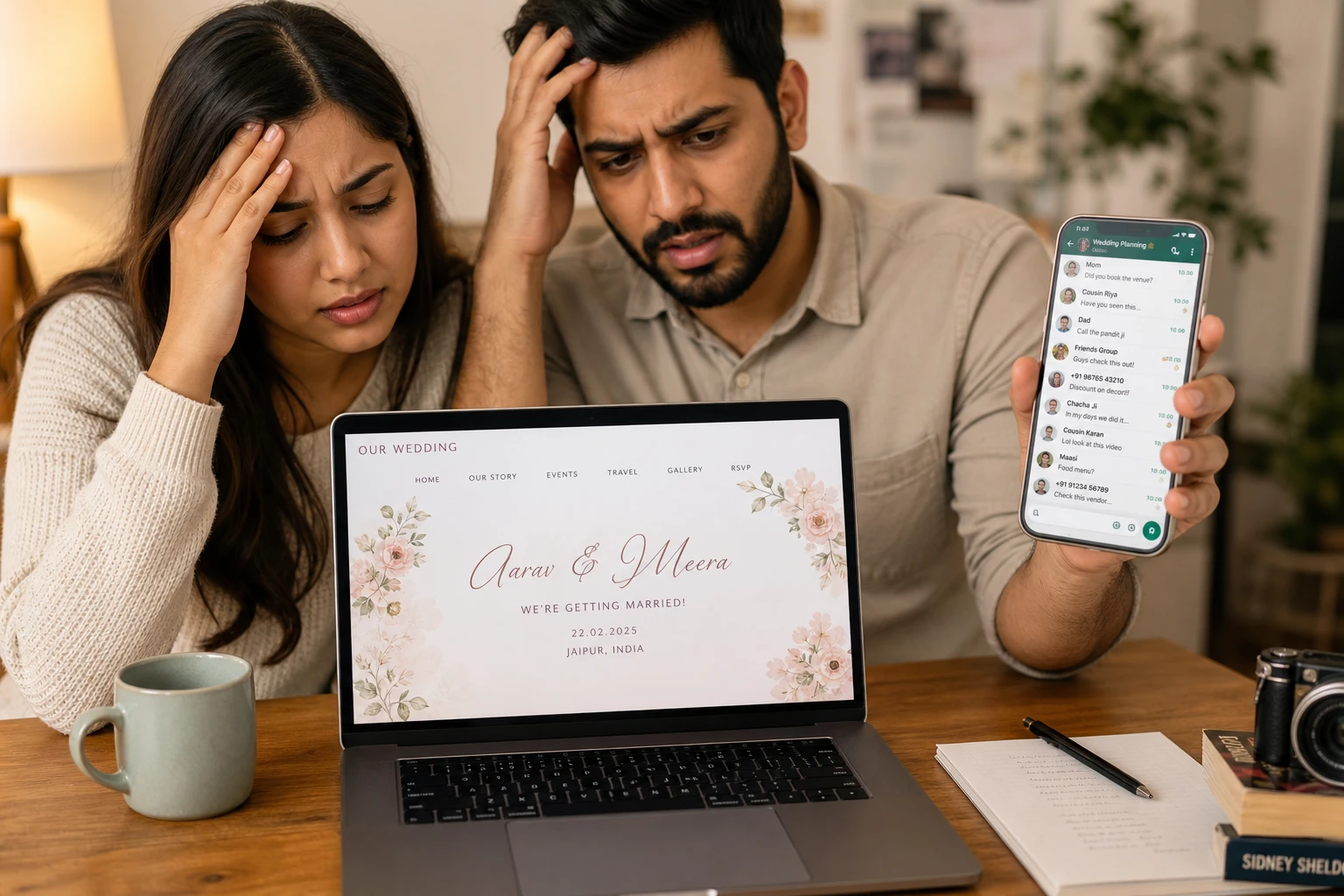
You discovered WhatsApp broadcast lists and thought: this is it. One message, straight to everyone, no group chat noise. Share the venue, the date, the dress code, the RSVP. Done.
And it is great! Until your cousin's number changed. Until someone asks for the venue address six weeks after you sent it and cannot find the message. Until you realize you have no idea who has actually confirmed attendance versus who just read the broadcast and assumed you knew they were coming.
A broadcast list is a one-time megaphone. Your wedding needs a permanent notice board.
What a WhatsApp Broadcast List Actually Does Well
Let's start with the honest case for broadcast lists, because they are genuinely useful:
Instant reach. A broadcast goes directly to everyone's personal chat in seconds. No group dynamics, no notifications of other people's replies. Clean, direct communication.
No group fatigue. A 200-person WhatsApp group is a lot. Updates can get buried. Someone will inevitably post something off-topic. A broadcast sidesteps all of that — each person receives it as a private message.
Familiar for all age groups. Your grandmother knows how to read a WhatsApp message. She might not know how to navigate to a website she received a link to three weeks ago.
Good for time-sensitive updates. Venue change? Ceremony time update? "The rains are heavy, please leave early." These time-sensitive messages belong in a broadcast.
Keep all of that. A wedding website does not replace broadcast lists. It supplements them.
Where a Broadcast List Falls Apart
Information does not persist. A message sent to 200 people on a Tuesday in March is almost impossible to find by the time guests are looking for venue details on a Friday in September. WhatsApp does not surface old messages well. Your broadcast message is buried under months of other conversations by the time it is needed.
No confirmation of comprehension. A broadcast message tells you who received it and who read it. It does not tell you who is actually coming to your wedding. "Seen" is not an RSVP.
No structure. A broadcast message is a paragraph of text. It cannot organize 300 guests by event, track dietary restrictions, show a running headcount, or tell you who has not responded.
No single source of truth. When guests receive a broadcast from you, they have a message in their personal chat. They do not have a place they can return to, check details, and find updated information. Every update requires another broadcast. Every correction requires another broadcast. If the venue changes twice before the wedding, guests have three conflicting messages in their chat history.
Relies on your phone number. If your SIM card is lost, your phone is damaged, or you change numbers, your broadcast list goes with it.
Cannot scale elegantly. A broadcast list with 250 contacts works. Managing RSVPs, tracking who has and has not responded, following up on non-responders, handling dietary restrictions, tracking plus-ones — none of that is possible within the broadcast framework. You need a separate spreadsheet. Then you need to maintain that spreadsheet. Then you need to reconcile it with your broadcast list. You have created more work, not less.
What a Wedding Website Does That a Broadcast Cannot
Think of your wedding website as the place your broadcast points to. The broadcast is the notification. The website is the information.
It is always up to date. Change the venue? Update the website once. Everyone who visits gets the correct information, regardless of when they saw your broadcast.
It answers questions without you. What time does the ceremony start? What is the dress code? Is there parking? How do I get there from the CBD? Can I bring my children? A wedding website answers these questions permanently, so you stop being the manual information desk for your own wedding.
It collects and tracks RSVPs. Not "seen" — actual confirmed attendance. With a phone number attached. Organized by event. Showing you who has not yet responded. Filtered by dietary restriction. This is a category of information a broadcast list cannot produce.
It organizes multiple events. Your ruracio guests need different information than your church wedding guests. Your website can show different events to different people. Your broadcast cannot.
It is shareable and permanent. Your website link is the same for every guest. You send it once (and pin it in your WhatsApp group). Guests bookmark it, reference it, share it with their spouses. It does not expire.
It handles the registry. When guests want to know how to contribute, you point them to the registry page — with your M-Pesa details displayed clearly. No individual messages explaining your Paybill number. No repeated texts with your personal M-Pesa number. One page, available to everyone, always findable.
See one link for everything wedding for more on how a single wedding website link can anchor your communication.
The Setup That Works: Both Together
Here is how broadcast lists and wedding websites fit together:
The website is the source of truth. Every permanent detail lives there: venue, time, dress code, RSVP link, registry.
Broadcast lists announce updates. "Big news — we've confirmed the venue! All details on the website." "The ceremony time has changed. Check the website for the updated schedule." "Two weeks to go! RSVPs close on Friday — link in message."
The broadcast is the push. The website is the pull. Together, they handle what neither can do alone.
A practical example:
- Early in planning: Set up your Harusi Hub wedding website with event details as you confirm them. Share the link via a broadcast to your guest list.
- Three months out: Send a broadcast reminder with the RSVP link from the website. "Please RSVP by October 1st."
- Six weeks out: Send a broadcast with venue directions. "Full details on the website."
- Week before: Send a broadcast with logistics. "See the website for timing and parking."
Each broadcast is short. Each broadcast points to the website for the full information. The website does the work of organizing, tracking, and being findable.
What About WhatsApp Groups?
Broadcast lists and WhatsApp groups serve different purposes. See wedding website vs WhatsApp group for the full breakdown.
The short version: broadcast lists are for one-way announcements. Groups are for community and conversation. Your wedding website is for permanent, organized information. All three together cover what your wedding communication needs.
Starting Your Wedding Website
Harusi Hub is free to start and takes less than an hour to get something live that your guests can reference. You do not need to have everything decided before you launch — add events, details, and pages as your planning progresses.
Once it is live, pin the link in your WhatsApp group and your broadcast list message. From that point, every update you make to the website reaches everyone who visits it, without another broadcast needed.
Your wedding's permanent notice board is ready when you are.
Give your guests a place to find everything — forever
Your wedding website works alongside your broadcast list. RSVPs, venue details, registry — all in one place, always up to date. Free to start.
Create Your Free Wedding Website