
Wedding Website with Swahili Support: Does Any Platform Offer It?
Most wedding website builders are English-only. We investigated which platforms offer Swahili support — and what the options are for Kenyan and Tanzanian couples.
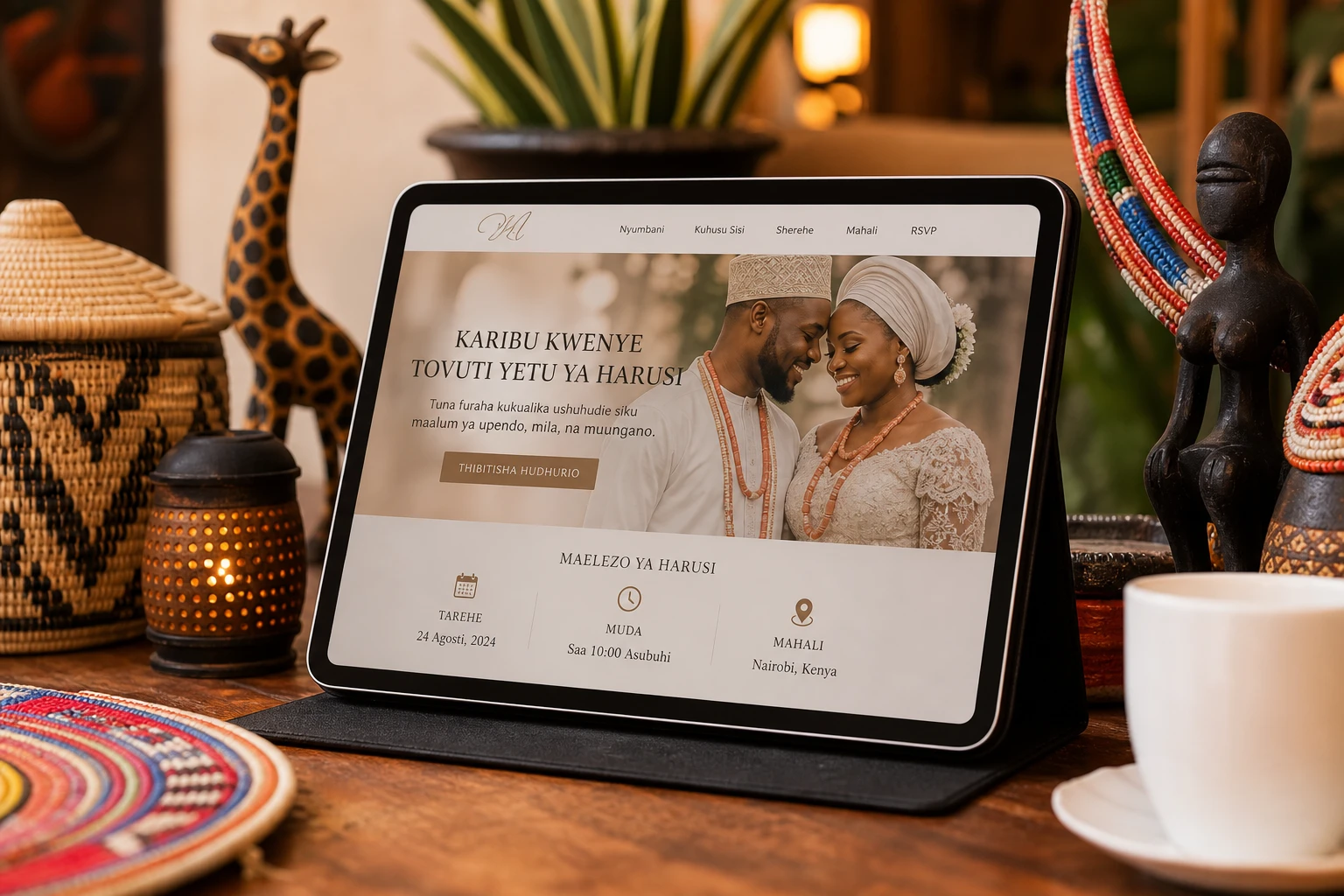
Swahili is spoken by an estimated 200 million people across East Africa, making it one of the most widely spoken languages on the continent. It is the national and official language of Kenya and Tanzania, a widely understood lingua franca in Uganda, Rwanda, Burundi, and the Democratic Republic of Congo, and one of the official languages of the African Union.
Yet if you visit any of the major wedding website platforms today — The Knot, Zola, WeddingWire, Joy, or Minted — you will find no Swahili language support. Not in the platform interface. Not in the template text. Not in the RSVP flow. Not anywhere.
This investigation examines what Swahili support actually means for a wedding website, which platforms offer any of it, and what the practical options are for Kenyan and Tanzanian couples who want their wedding website to reflect their language.
What Swahili Support Means for a Wedding Website
"Swahili support" is not a single feature — it encompasses several distinct capabilities:
Interface language. Can the couple set up the platform in Swahili? Can they navigate menus, settings, and editor tools in Swahili rather than English?
Template and placeholder text. When a couple creates a new page, does the default placeholder text appear in Swahili? Do template designs default to Swahili headings?
Guest-facing RSVP form. When guests open the RSVP form, is it presented in Swahili? Can guests read and respond to questions in Swahili?
Custom content in Swahili. Can the couple write content (their love story, event descriptions, FAQ answers) in Swahili, and does it display correctly?
Character and text rendering. Does the platform render Swahili text correctly, without character display issues?
These are different layers. A platform might allow custom content in Swahili (because it is just a text field) without offering any Swahili in the interface or default templates.
Platform Assessment
The Knot
The Knot is English-only for interface, templates, and RSVP flows. Couples can write custom content pages in Swahili, and the text renders correctly. There is no Swahili in the platform interface, default text, or automated communications.
Swahili support: Custom content only
Zola
Same as The Knot. English-only interface and templates; custom content fields accept Swahili text and render it correctly.
Swahili support: Custom content only
WeddingWire
English-only throughout. WeddingWire operates localized versions in Spain, France, Germany, and Portugal (via its Bodas.net properties), but no African language versions exist.
Swahili support: Custom content only
Joy (WithJoy)
English-only. Custom content in Swahili is possible.
Swahili support: Custom content only
Minted
English-only.
Swahili support: Custom content only
Harusi Hub
Harusi Hub is designed specifically for the Kenyan and East African market. The platform includes Swahili terminology in its interface — wedding-specific terms like harusi (wedding), sherehe (celebration), and wageni (guests) are used contextually rather than the generic English defaults that US platforms use.
Custom content in Swahili is fully supported, with correct rendering and no character issues. The platform's terminology and cultural framing reflect a Swahili-speaking context, even where the primary interface language remains English.
Full Swahili-language interface and guest-facing forms are on the product roadmap. As of 2026, the platform is English-first with Swahili cultural context built in.
Swahili support: Cultural context + custom content; full language support in development
Inawo
Inawo is English-first, designed for the Nigerian market. Custom content in Swahili renders correctly.
Swahili support: Custom content only
The Practical Reality
No major wedding website platform offers complete Swahili language support today. This means that for Kenyan and Tanzanian couples who want a bilingual or fully Swahili wedding website, the options are:
Write everything in Swahili. On any platform that supports free-text content pages, you can write your love story, event descriptions, FAQ, and registry information entirely in Swahili. The couple interface will remain in English, but guests will see your Swahili content. This is the most practical option on any platform, including Harusi Hub.
Bilingual content. Write content in both English and Swahili — English for international guests and diaspora family, Swahili for guests who are more comfortable in the language. This is achievable on any platform with flexible text fields.
Wait for native support. Harusi Hub has indicated that Swahili interface support is on its development roadmap. For couples who can wait, native Swahili support may be available in the near-term future.
What Swahili Cultural Context Means
There is a difference between Swahili language support (the interface is in Swahili) and Swahili cultural context (the platform understands what a harusi involves).
US platforms provide neither. They are built on American wedding conventions: one ceremony, email-based RSVPs, retail registries, USD pricing. The language is English, but the cultural assumptions are American.
Harusi Hub provides cultural context even where the language is primarily English. The platform is built around the reality of Kenyan weddings — multiple ceremonies, M-Pesa contributions, phone-based RSVPs, guest lists that span different family networks. The terminology reflects this. The features reflect this.
For Swahili-speaking couples, cultural context is arguably more important than interface language. A platform that understands what a ruracio is, that supports M-Pesa contributions for harambee gift-giving, and that handles a multi-event harusi without workarounds serves Swahili-speaking couples better than a platform with a Swahili interface but American wedding assumptions.
A Note on Tanzanian Couples
Swahili is more dominant in Tanzania than Kenya — it is the primary language of education, government, and daily communication, with English as a secondary language. Tanzanian couples planning a wedding website face the same platform landscape as Kenyan couples: English-only interfaces with no Swahili support, and no African-built alternative that currently targets the Tanzanian market specifically.
Harusi Hub's focus is currently Kenya-first. Tanzanian couples can use the platform — there are no geographic restrictions — but the local context is primarily Kenyan. Broader East African market coverage is a logical expansion for the platform.
Recommendations for Swahili-Speaking Couples
Short-term: Use Harusi Hub and write your guest-facing content in Swahili. The platform supports Swahili text correctly, understands the Kenyan/East African wedding context, and provides the features (phone RSVPs, M-Pesa registry, multi-event support) that matter most. The interface is English, but guests will see your Swahili content on their event pages, RSVP forms, and registry.
For fully Swahili content: Harusi Hub's free-text pages let you write everything in Swahili. Event descriptions, love story, FAQ, registry details — all can be in Swahili.
For bilingual weddings: Write content in both languages. Harusi Hub's page editor handles this well — you can structure pages with English headings and Swahili body text, or vice versa, depending on your guest mix.
See best free wedding website builders Kenya and best wedding website builders Africa for the broader platform landscape.
A wedding website that understands your wedding
Write your content in Swahili. Built for Kenya. Phone RSVPs, M-Pesa registry, multi-ceremony support. Free to start.
Create Your Free Wedding Website