
Best Wedding Guest List Apps for Large Kenyan Weddings
Compare the best wedding guest list apps for managing 200-800 guests in Kenya. Track RSVPs, tables, meals, and attendance without the chaos.
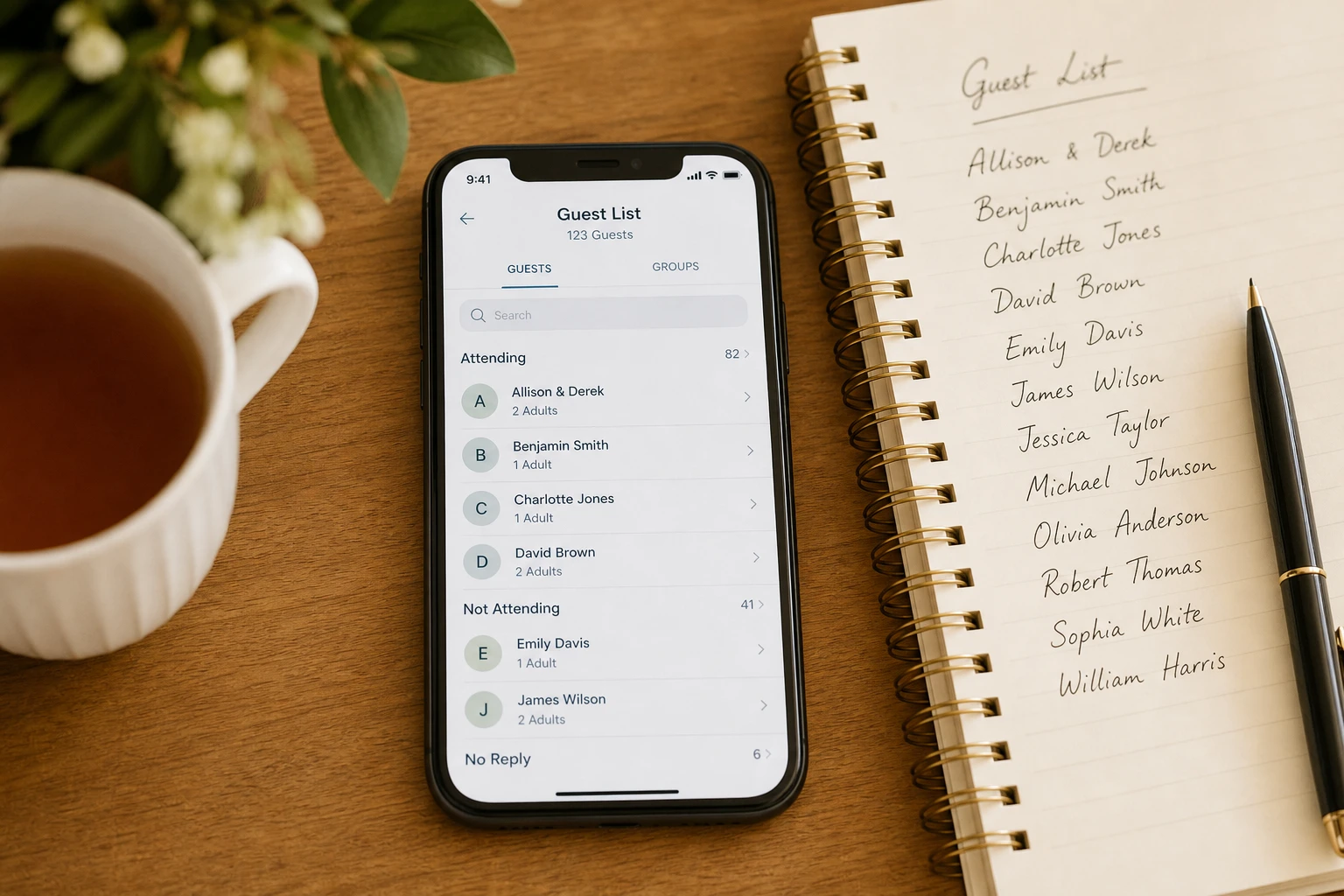
A Kenyan wedding with 300 guests is not unusual. A wedding with 500 is common. Some families host receptions north of 800. Managing a guest list at that scale — tracking RSVPs, meals, table assignments, plus-ones, and attendance across multiple events — is a logistics problem, not a social one.
Most wedding apps are designed for US weddings averaging 150-175 guests. At that scale, a spreadsheet is manageable. At 400 guests across two or three events, you need something better.
This article ranks guest list tools on their ability to handle large, complex Kenyan wedding logistics.
What Makes a Large Kenyan Wedding Guest List Different
Several factors push Kenyan wedding guest lists into complexity territory quickly:
Multiple events. Many couples host a ruracio or introduction ceremony, a church service, and a main reception — each with a different guest list. Some guests attend all three; others attend one. The church list and reception list rarely match exactly.
Extended family structures. Invitations often go to family units, not individuals. "The Mwangi family" might mean 4-12 people. The tool needs to handle group invitations and count heads accurately.
Mixed contact methods. Some guests have email. Most have WhatsApp. Some only have a phone number on record. A tool that requires email for every guest will leave gaps.
Late RSVPs and walk-ins. Kenyan wedding guest lists are rarely final until the day before, and sometimes not even then. The tool needs to handle last-minute additions and on-the-day attendance tracking.
Meal selection. Large weddings with sit-down meals need meal preference tracking per guest. Catering contracts are often priced per head with category breakdowns.
Evaluation Criteria
- Scale: How many guests can it handle?
- Multi-event management: Separate lists per event within one wedding
- Group invitations: Inviting family units, not just individuals
- Phone-only guests: Guests with no email address
- RSVP tracking in real time
- Table/seating assignment
- On-the-day attendance check-in
- Export capability
Platform Breakdown
1. Harusi Hub
Harusi Hub's guest list management is built for Kenyan wedding scale. There is no cap on guest count on the free plan. The platform handles multi-event guest segmentation, phone-only contacts, and real-time RSVP tracking.
What it does well:
- No guest count limit
- Guests can be assigned to specific events (ruracio, church, reception) — one guest record, multiple event assignments
- Phone number as the primary contact identifier (email optional)
- Real-time RSVP dashboard with response counts per event
- Meal preference collection per guest
- Table and seating management
- On-the-day check-in view (the couple or coordinator can mark attendance from a phone)
- Export to CSV for sharing with venue or coordinator
- Bulk import from CSV or contacts
Limitations:
- Table layout is list-based, not a visual drag-and-drop floorplan
- No integration with external seating tools like AllSeated
Price: Free.
Best for: Any Kenyan couple with a guest list over 100, especially those managing multiple events and mixed contact types.
See also: How to Manage Your Wedding Guest List Online
2. AllSeated
AllSeated is a professional-grade seating and guest list management tool used by event planners globally. It is the strongest option on this list for visual table layout and seating arrangement.
What it does well:
- Visual floorplan builder — drag guests to tables on a room layout
- Collaboration with venue coordinators and planners
- Guest list management with RSVP tracking
- Meal preference and dietary restriction tracking
- Export to multiple formats
What doesn't work for Kenya:
- RSVP collection requires email addresses
- No phone-first RSVP option
- Designed for professional planners; the interface is complex for couples managing their own lists
- No M-Pesa or KES integration
- No multi-event structure within a single wedding record
Price: Free tier available; full features on paid plan.
Best for: Couples working with a professional wedding coordinator who needs a floorplan-level seating tool. Not a primary tool for self-planning couples in Kenya.
3. Joy (WithJoy.com)
Joy includes a solid guest list management module that works well for moderate-sized guest lists with good email coverage.
What it does well:
- Clean guest list interface
- Real-time RSVP tracking
- Group management (invite by household)
- Meal preference collection
- Plus-one tracking with name collection
- Export to CSV
What doesn't work for Kenya:
- Email-centric: guests who respond without email are hard to track properly
- No phone-number-only guest management
- Multi-event support exists but is limited compared to Harusi Hub
- At 400+ guests, the interface can become slow on mobile
Price: Free tier with core features.
Best for: Couples with under 250 guests and mostly email-enabled contacts.
4. Zola
Zola's guest list tool follows the same pattern as Joy. Strong for email-centric, moderate-scale guest lists. Less suited to large or phone-first Kenyan wedding logistics.
What it does well:
- RSVP tracking per event
- Meal and dietary preference collection
- Address collection for physical invitations
- Seating chart tool included
What doesn't work for Kenya:
- Email required for guest tracking
- Seating chart is US-focused (doesn't account for head table structures common in Kenyan receptions)
- No phone RSVP option
- Performs adequately at 200 guests; becomes harder to manage at 400+
Price: Free.
Best for: Couples planning a moderately sized wedding with email-capable guests.
5. Excel / Google Sheets
At large scale, many Kenyan wedding coordinators default to Excel because they can structure it exactly as needed. This is a legitimate choice but comes with real costs.
What works:
- Unlimited rows (unlimited guests)
- Fully customisable structure
- Phone and email both supported as columns
- Multiple sheets for multiple events
- Shareable with family members and coordinators
What doesn't work:
- No real-time RSVP collection — guests can't submit responses directly
- Manual entry creates data entry errors
- No on-the-day check-in functionality
- No automated reminders for non-responders
- Version control is a problem when multiple people are editing
Price: Free.
Best for: Couples with a planner handling coordination, or as a backup when other tools fail. Not a primary tool recommendation for self-planning couples.
Comparison Table
| Feature | Harusi Hub | AllSeated | Joy | Zola | Google Sheets |
|---|---|---|---|---|---|
| No guest count limit | Yes | Yes | Yes | Yes | Yes |
| Multi-event guest segmentation | Yes | No | Limited | Limited | Manual |
| Phone-only guests | Yes | No | No | No | Yes |
| Real-time RSVP tracking | Yes | Yes | Yes | Yes | No |
| Meal preference per guest | Yes | Yes | Yes | Yes | Manual |
| Table/seating tool | List-based | Visual floorplan | Yes | Yes | Manual |
| On-the-day check-in | Yes | Yes | No | No | No |
| Export to CSV | Yes | Yes | Yes | Yes | Native |
| Free | Yes | Partial | Yes | Yes | Yes |
Final Recommendation
For large Kenyan weddings, Harusi Hub is the strongest all-round option: no guest count limit, multi-event segmentation, phone-first RSVP, and on-the-day check-in. It handles the specific complexity of Kenyan wedding logistics without requiring workarounds.
If you are working with a professional coordinator and need a visual floorplan tool, AllSeated is worth adding alongside Harusi Hub. The two tools serve different functions: Harusi Hub for guest management and RSVPs, AllSeated for physical seating layout.
For smaller weddings (under 200 guests) with email-capable contacts, Joy and Zola are excellent. They are cleaner to use and have stronger template libraries.
Google Sheets remains the fallback for couples who need maximum flexibility, but at 400+ guests it becomes a liability without deliberate structure.
Manage your full guest list for free with Harusi Hub →
Related reading: