
The Knot RSVP System vs Phone-Based RSVP: Which Reaches More Guests?
The Knot's email RSVP vs phone-based RSVP for Kenyan weddings — response rates, friction points, and which system gets you an accurate headcount.
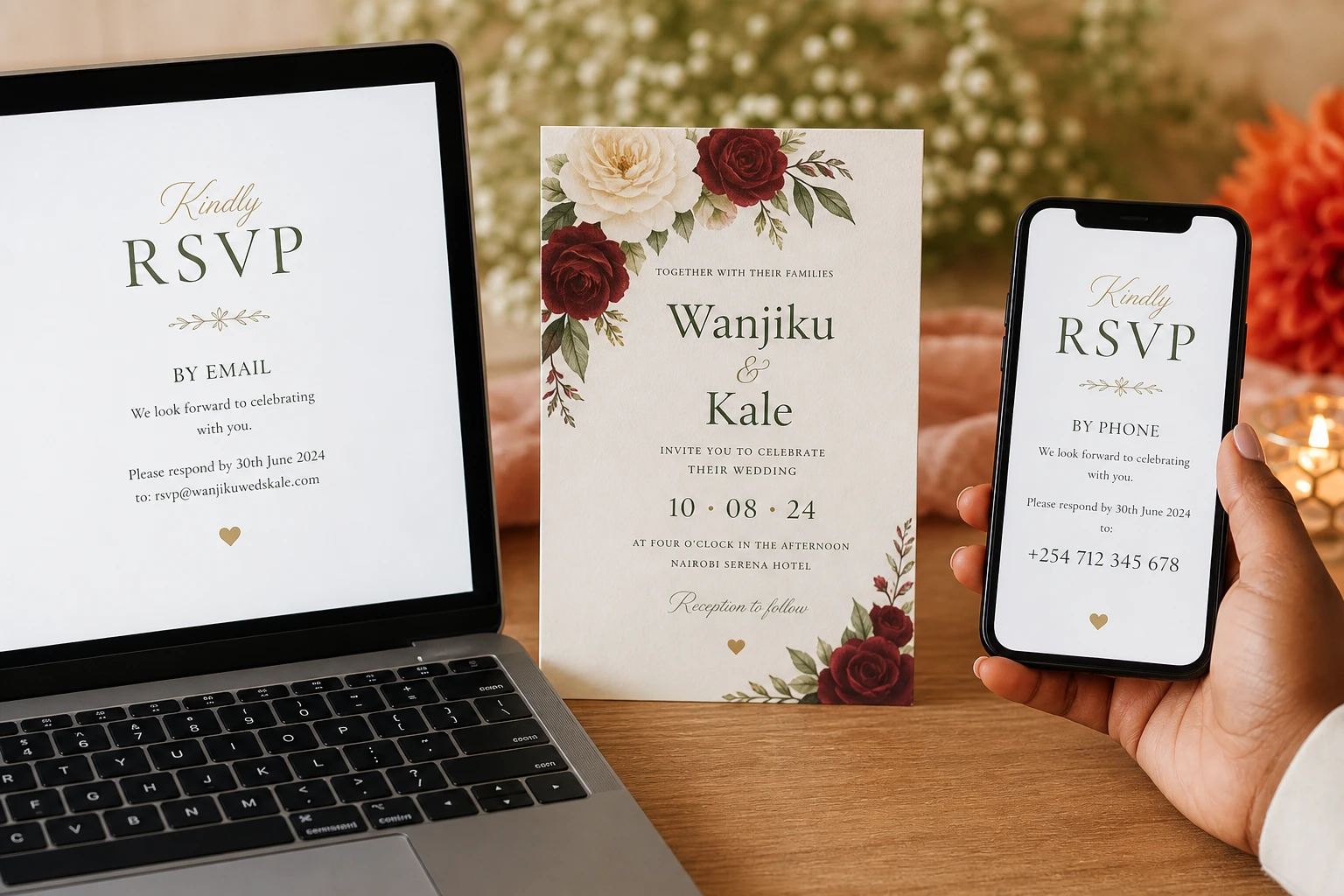
Your RSVP system is only as useful as the responses it collects. A guest who cannot easily respond is a guest who does not respond — and that gap shows up in your headcount.
Getting an accurate headcount is one of the most practically important tasks in wedding planning. Caterers, venue managers, and hire companies all need confirmed numbers, often weeks in advance. A 20-person discrepancy in your final count can cost tens of thousands of shillings in over-ordered food or force a last-minute scramble when more guests arrive than expected.
The RSVP system you choose determines how many of your guests actually respond. This comparison examines how The Knot's built-in RSVP system works, how phone-based RSVP works, and which approach gets a higher response rate for weddings in Kenya.
How The Knot's RSVP System Works
When a couple uses The Knot's wedding website, guests are directed to an RSVP page. The RSVP flow requires the following steps:
- Guest opens the wedding website link.
- Guest finds their name in the guest list search.
- Guest enters or confirms their email address.
- Guest selects attendance, meal preference (if configured), and any other questions.
- Guest receives an email confirmation.
What works well:
- The interface is clean and straightforward for guests who use email regularly.
- Responses are logged automatically to the couple's dashboard.
- The system supports meal preferences, plus-ones, and custom questions.
- Email confirmations give guests a record of their RSVP.
What creates friction:
The email requirement is the primary friction point. Guests must have an email address and must be willing to use it to RSVP. For couples in the United States, where email is embedded in daily communication, this is a reasonable assumption. For Kenyan couples, it is less so.
The Kenyan Guest Profile
Understanding why phone-based RSVP performs differently requires looking at who attends Kenyan weddings and how they communicate.
Smartphone penetration in Kenya continues to grow, but WhatsApp and SMS remain the dominant daily communication channels for most adults across age groups. Email is used primarily in professional settings — many Kenyans have email accounts tied to work but do not check personal email frequently or at all.
Guest age distribution at Kenyan weddings tends to be wide. Weddings routinely include guests in their 60s, 70s, and older — parents, grandparents, aunties, uncles — alongside younger guests. Older guests are less likely to have active personal email accounts or comfort navigating a web-based RSVP form.
Feature phone usage remains present, particularly in upcountry and rural areas. Guests on feature phones cannot access a web RSVP page at all.
The practical result: a significant portion of a typical Kenyan wedding guest list cannot or will not complete an email-based RSVP without direct assistance from the couple.
How Phone-Based RSVP Works
Phone-based RSVP, as implemented on platforms like Harusi Hub, works differently from email RSVP in a few key ways.
- The couple adds guests to their dashboard with phone numbers (not email addresses).
- Each guest receives a unique RSVP link via WhatsApp or SMS.
- The guest opens the link, taps their attendance, and submits.
- No email address is required. No account creation is required. No app download is needed.
- The couple's dashboard updates in real time.
For a detailed walkthrough of the mechanics, see How to Collect Wedding RSVPs by Phone Number.
Direct Comparison: Key Dimensions
Access
| Dimension | The Knot (email RSVP) | Phone-based RSVP |
|---|---|---|
| Requires email address | Yes | No |
| Works on feature phones | No (web RSVP) | Yes (SMS link) |
| Works on WhatsApp | Indirect only | Direct link delivery |
| App download required | No | No |
| Account creation required | No (but email needed) | No |
Friction
The number of steps between "received the RSVP request" and "RSVP complete" directly predicts response rates. More steps mean more drop-off.
The Knot flow: Receive link → open website → search for name → enter email → complete form → receive confirmation email. (5-6 steps, requires email)
Phone-based RSVP flow: Receive WhatsApp/SMS link → tap link → tap attendance → done. (3 steps, no email required)
Response rate factors
Neither The Knot nor Harusi Hub publishes direct response rate data. But the friction analysis suggests phone-based RSVP is more likely to achieve higher completion rates with a typical Kenyan guest list, for three reasons:
- The delivery channel matches how guests actually communicate (WhatsApp/SMS vs email).
- Fewer steps to completion means less drop-off.
- No email requirement removes the most common barrier for older guests.
Tracking and management
| Dimension | The Knot | Phone-based RSVP (Harusi Hub) |
|---|---|---|
| Real-time dashboard | Yes | Yes |
| Meal preference collection | Yes | Yes |
| Plus-one management | Yes | Yes |
| Follow-up reminders | Limited | Yes (via WhatsApp/SMS) |
| Export to spreadsheet | Yes | Yes |
| Multiple events (traditional + church) | Limited | Yes |
The Response Gap Problem
Here is the practical issue: a RSVP system that does not reach all your guests does not give you an accurate headcount. It gives you a partial headcount — and you will not know which guests are missing.
With email RSVP, the couples most affected are those with guest lists that skew older or are spread across different connectivity levels. A 200-person guest list where 60 guests cannot or will not use email RSVP leaves a 30% gap in your data. You will chase those guests by phone anyway — which adds work rather than removing it.
With phone-based RSVP, the follow-up still exists for non-responders, but the initial friction is lower across a broader set of guests. The couple's starting point is typically a higher baseline response rate before follow-up begins.
When The Knot's RSVP Works Well
The Knot's RSVP system is well-suited for:
- Couples with guests primarily in the US or UK, where email-based RSVP matches the communication norms of most guests.
- Weddings with younger, digitally active guest lists who check email regularly.
- Couples who need the website and RSVP in one US-focused platform, particularly if they have US guests who benefit from the broader Knot ecosystem.
The Knot's RSVP is a reasonable tool for the market it was designed for. The friction it creates is specific to contexts — like Kenya — where email is not the primary communication channel.
Recommendation for Kenyan Couples
If your guest list is primarily in Kenya, phone-based RSVP is the more practical system. The reasons are structural:
- Delivery via WhatsApp or SMS matches how your guests communicate.
- No email requirement removes the most common barrier.
- Older guests can respond without needing to navigate email or create accounts.
- Follow-up is easier when you already have phone numbers in the system.
If you have a mixed guest list — some in Kenya, some internationally — it is worth evaluating whether a single system can serve both groups, or whether the phone-based approach covers enough of your guest list to be worth the switch.
Getting Started with Phone-Based RSVP
Harusi Hub's RSVP system is free to use. The setup process:
- Create a wedding on Harusi Hub.
- Add your guest list with phone numbers.
- Send RSVP links via WhatsApp or SMS directly from the dashboard.
- Track responses in real time.
No email required — for you or your guests.
For a step-by-step walkthrough, see How to Collect Wedding RSVPs by Phone Number or How to Manage Your Wedding Guest List Online.
Summary
The Knot's RSVP system is well-built for the guest profile it was designed around: English-speaking, email-using, primarily North American guests. For Kenyan couples, the email requirement creates a structural gap that grows with the age distribution and digital habits of a typical Kenyan guest list.
Phone-based RSVP matches how Kenyan guests communicate. It reduces friction at the collection step, which typically translates to a higher response rate before manual follow-up is needed.
The question is not which system looks better on a feature list. It is which system your guests will actually use.
Related reading: How to Collect Wedding RSVPs by Phone Number | Does The Knot Work in Kenya? | Harusi Hub vs The Knot vs Zola