
Does The Knot Work in Kenya? What Couples Need to Know
The Knot is one of the world's largest wedding platforms. But does it work for Kenyan couples? An honest, data-driven look at what it offers and where it falls short.
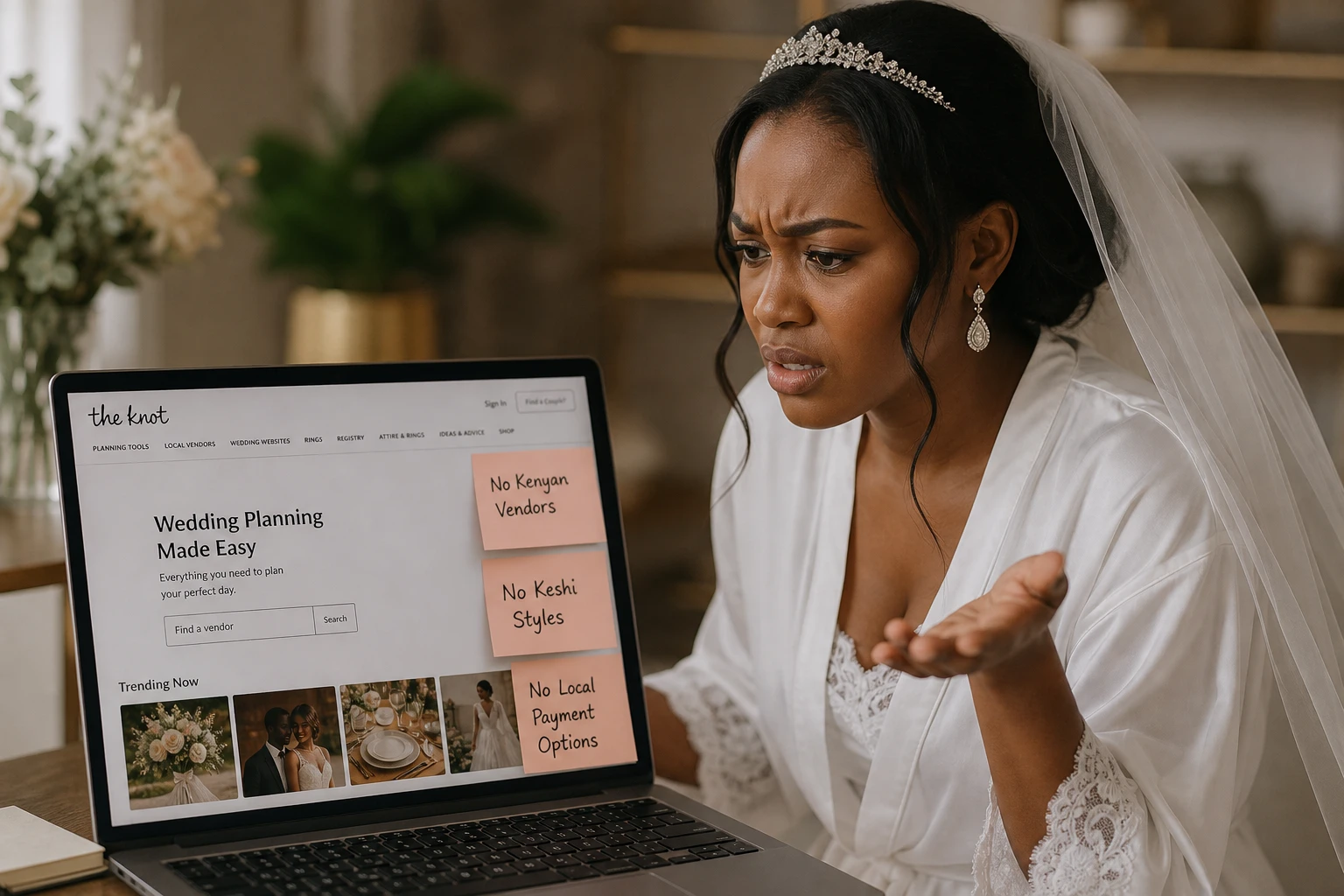
The Knot is one of the most searched wedding platforms in the world. Couples in Kenya land on it regularly while looking for tools to plan their weddings. Whether it actually helps them is a different question.
The Knot is a genuine accomplishment. Founded in 1996, it has grown into the largest wedding marketplace in the United States — with over 300,000 listed vendors, 800 website design templates, and a suite of planning tools used by millions of couples every year. Its parent company, The Knot Worldwide, also owns WeddingWire and Hitched, giving it reach across multiple English-speaking markets.
For a couple in New York or Chicago, The Knot is an obvious first stop. For a couple in Nairobi, Mombasa, or Kisumu, the story is more complicated.
This article examines The Knot's features with a specific focus on what works, what does not, and what the platform simply cannot offer couples planning weddings in Kenya.
What The Knot Actually Offers
Before assessing fit, it is worth understanding what The Knot includes at no cost.
Wedding website builder. The Knot provides a full website builder with over 800 design templates. Couples can publish a wedding website, share event details, collect RSVPs, and display registry information. Custom domain names are available for a fee (around $19.99 per year). The design quality is high — the templates are professionally built and cover a wide range of aesthetics, from minimalist to elaborate.
Vendor marketplace. The Knot hosts over 300,000 vendors across the United States and Canada. Couples can search for photographers, caterers, florists, venues, and other service providers by location, style, and budget range. Reviews and ratings are visible on each listing.
Planning tools. The platform includes a budget tracker, guest list manager, checklist, and seating chart builder. These are woven into a single dashboard, making it a reasonably complete planning hub for the couples it was designed for.
Registry. The Knot integrates with over 25 major US retail stores — including Crate & Barrel, Williams-Sonoma, and Amazon — allowing couples to build a single registry that pulls from multiple sources. It also supports a cash fund feature.
Cost. The core platform is free. This is not a trial — The Knot operates on a vendor advertising model and passes the website and planning tools to couples at no charge.
These are genuine strengths. Any honest assessment of The Knot has to acknowledge them.
Where The Knot Falls Short for Kenya
The Vendor Directory Has Zero Kenyan Listings
The Knot's 300,000-vendor directory is entirely North American. There is no mechanism to list or discover vendors in Kenya, and no plans to expand into African markets have been announced. For a couple searching for a photographer in Westlands or a caterer in Thika, The Knot's vendor directory is not just unhelpful — it does not exist for them.
This is not a minor gap. Vendor discovery is one of the primary reasons couples use a platform like The Knot in the first place. Losing that function eliminates a significant portion of the platform's value proposition.
Email-Only RSVP Creates Friction for Kenyan Guests
The Knot's RSVP system requires guests to have and use an email address. To RSVP on The Knot, a guest must either create an account on the platform or enter their email address to receive a confirmation.
This works smoothly in markets where email is the default communication channel. It works less well in Kenya, where the dominant personal communication tools are WhatsApp and SMS, and where a meaningful portion of guests — particularly older relatives — do not have active email accounts or check them regularly.
Asking a grandmother in rural Murang'a to RSVP via email is not a realistic request. Asking a large group of guests who primarily use feature phones is similarly unrealistic. A RSVP system that creates friction for guests tends to produce incomplete data — which is the precise problem a RSVP system is meant to solve.
For a more detailed breakdown of how phone-based RSVP compares to email-based systems in the Kenyan context, see The Knot RSVP System vs Phone-Based RSVP: Which Reaches More Guests?.
Registry Integrations Are US-Only
The Knot's registry system integrates exclusively with American retail stores. None of the 25+ partner retailers ship to Kenya, accept M-Pesa, or operate physical stores on the continent. For a Kenyan couple, the registry feature as designed cannot be used.
The Knot does offer a "cash fund" option that allows couples to collect monetary gifts. However, this feature comes with a 2.5% processing fee — paid by the guest, not absorbed by the couple. In a context where cash gifts (rather than physical registry items) are already the dominant gift format at Kenyan weddings, a platform that charges guests 2.5% to give cash creates friction that most couples would prefer to avoid.
No Local Context Throughout
Wedding planning in Kenya involves processes and considerations that US-focused platforms have no reason to account for. Traditional ceremonies, dowry negotiations (ruracio or lobola), multi-day wedding programs, county permits for certain venues, M-Pesa payment workflows — these are structural elements of a Kenyan wedding that The Knot's tools do not reflect.
The planning checklists reference vendors and timelines based on US wedding norms. The budget tracker uses USD by default. The advice content is written for American audiences. These are not criticisms of The Knot as a product — it was built for a specific market. They are relevant observations for Kenyan couples evaluating whether to use it.
What The Knot Does Well (Honestly)
Template quality is high. The 800-template library is one of the largest in the industry, and the design quality is consistently strong. If aesthetic variety and polish matter to a couple, The Knot's website builder delivers.
The platform is genuinely free. Unlike some competitors, The Knot does not limit planning tools behind a paywall. Couples can use the full wedding website and planning suite without paying.
The scale of the US vendor network is useful if the couple has US-based guests or vendors. For destination weddings with US-based planning needs, or for couples with significant guest bases in the United States, The Knot's vendor directory has real value.
The platform is well-designed and stable. The Knot has been operating for nearly 30 years. Its product is reliable, well-supported, and has a large community of users.
The Core Issue
The Knot is not a bad platform. It is a platform built for a specific geography, and that geography is the United States. Its vendor directory, RSVP system, registry integrations, and planning content are all designed around the assumptions of an American wedding. Those assumptions do not hold in Kenya.
This is not unusual. Most major wedding platforms share the same limitation — they were built in and for North America or Western Europe, and have not extended to African markets.
What Kenyan Couples Are Using Instead
Harusi Hub was built specifically for Kenyan and African couples. The differences are structural, not cosmetic:
- RSVP by phone number. Guests RSVP via a link without needing an email address or app download. This is the most common request from Kenyan couples switching from email-based RSVP tools.
- Kenyan vendor directory. The platform lists vendors operating in Kenya — photographers, caterers, decorators, and venues — searchable by location.
- M-Pesa support. Payment flows and cash gift collection are built around M-Pesa, not credit cards or USD.
- Multi-event programs. Traditional ceremonies, religious ceremonies, and receptions can be managed under a single wedding, reflecting the multi-day structure common in Kenyan weddings.
- Free. Like The Knot, the core platform is free to use.
A full feature comparison between the two platforms — and with Zola — is available at Harusi Hub vs The Knot vs Zola: Which Works for Kenyan Weddings?.
Summary
| Feature | The Knot | Harusi Hub |
|---|---|---|
| Price | Free (custom domain $19.99/yr) | Free (subdomain included) |
| Vendor directory | 300K+ (US/Canada only) | Kenya-focused |
| RSVP method | Email required | Phone number, no email needed |
| M-Pesa support | No | Yes |
| Registry integrations | 25+ US retailers | Local cash gifting |
| Cash fund fee | 2.5% (charged to guest) | No fee |
| Multi-event support | Limited | Yes |
| Design templates | 800+ | Growing library |
| Local planning content | US-focused | Kenya-specific |
For couples planning weddings outside the United States, the honest answer to "does The Knot work in Kenya?" is: partly. The website builder functions. The planning checklist is usable as a general framework. But the core value-add features — vendor discovery, guest RSVP, and registry — either do not work in Kenya or do not work for the way Kenyan weddings are planned.
If you're looking for a platform that was built for where you're getting married, that's a different search.
Related reading: Harusi Hub vs The Knot vs Zola | The Knot RSVP vs Phone-Based RSVP | Best Wedding Website Builders for Africa