
Planning a Hindu-Christian Wedding in Kenya: Ceremony, Legal, and Family
A practical guide for Hindu-Christian couples in Kenya — how to handle the legal process, combine ceremonies respectfully, and navigate family expectations.
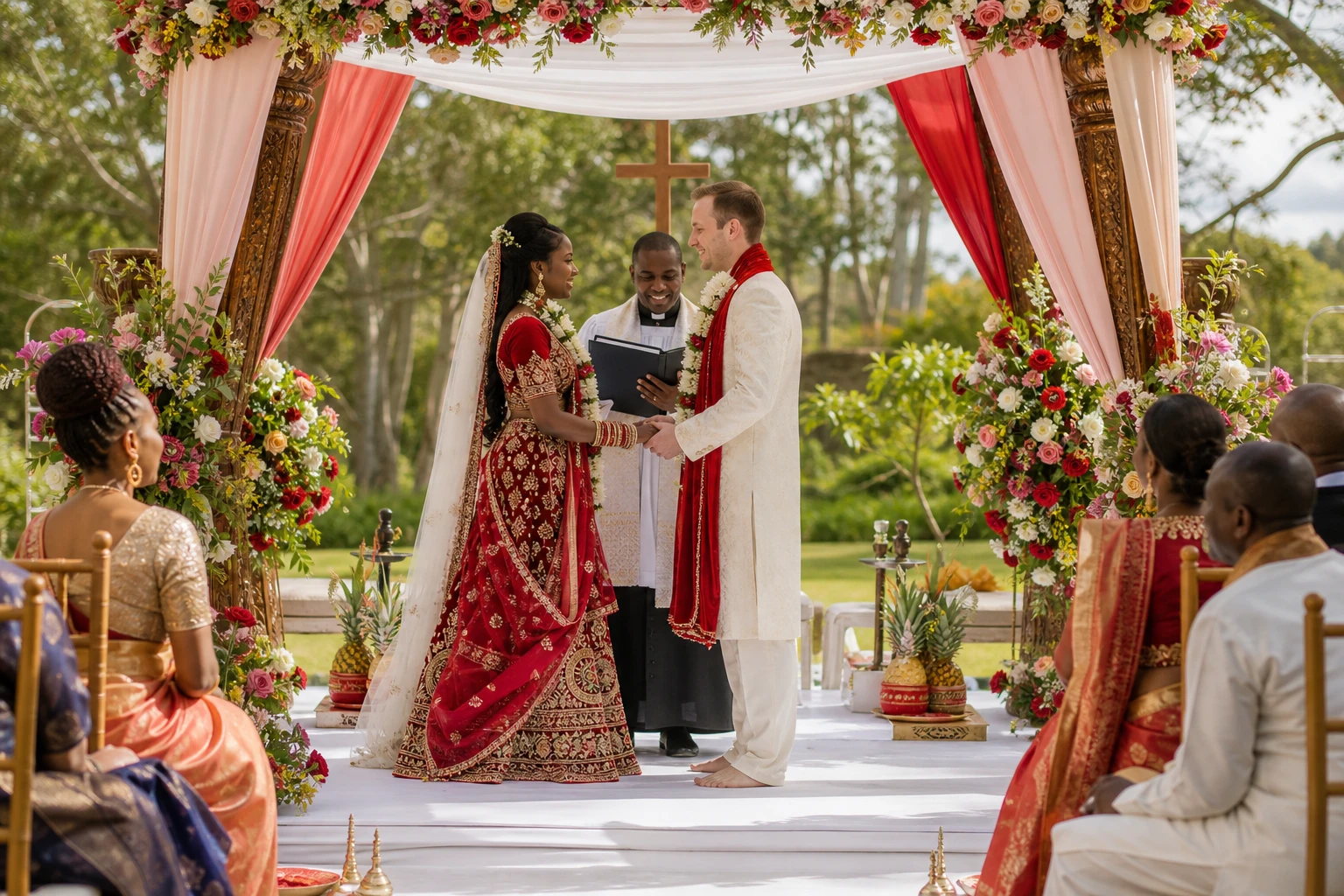
Between the mandap and the altar, there is a whole wedding to plan — and the question of how to honor both faiths without shrinking either one.
Hindu-Christian weddings in Kenya are more common than many people assume, particularly within the Indian-Kenyan community where generations of families have built lives alongside neighbors of different faiths. When love crosses these lines, the result is a wedding that can be extraordinarily rich — two sets of rituals, two palettes of color and meaning, two families bringing their traditions into the same room.
But it requires deliberate planning. The legal structure, the ceremony design, and the family dynamics each demand attention. Here is what you need to know.
The Legal Landscape First
Kenya's Marriage Act 2014 is clear: a Hindu marriage requires that both parties profess the Hindu faith. If one partner is Christian, a legally recognized Hindu marriage under the Act is not available unless one partner converts — a decision that must never be made for administrative convenience alone.
The practical solution most Hindu-Christian couples use is a civil marriage registered at the Registrar of Marriages. This is a legally binding marriage with no religious requirements. Once registered civilly, you are free to hold religious ceremonies — a Hindu vivah (or elements of one), a Christian blessing or church service — as faith celebrations rather than legal registrations.
Some couples also choose to register their union through a Christian marriage if one partner is already active in a church that will solemnize the wedding, and then hold the Hindu ceremony separately as a cultural celebration. Either path is valid. The key is understanding the distinction between legal registration and religious ceremony.
For a full walkthrough of registering a Hindu marriage in Kenya and what the process involves, see our guide on Hindu marriage registration in Kenya. For the civil route, see our civil marriage guide.
Designing the Ceremonies
The Hindu Ceremony
A traditional Hindu wedding — the vivah — is one of the most visually and spiritually layered ceremonies in the world. Central rituals typically include:
- Ganesh puja: Prayers to remove obstacles before the ceremony begins
- Kanyadaan: The bride's father giving her hand — one of the most emotionally significant moments
- Saptapadi: The seven steps around the sacred fire, each representing a vow
- Sindoor and mangalsutra: The groom applying sindoor and tying the mangalsutra around the bride's neck
A Hindu priest (pandit) officiates. The ceremony is conducted in Sanskrit, with families often providing translations or explanations for guests unfamiliar with the rituals.
For couples where only one partner is Hindu, speak with your pandit early. Some pandits are comfortable officiating a ceremony for a mixed-faith couple; others are not. Finding the right officiant — one who can hold the ceremony with integrity while welcoming a non-Hindu partner — makes an enormous difference.
The Christian Ceremony
Depending on denomination, a Christian ceremony may be a full sacramental wedding or a blessing service. Catholic churches, for example, have specific policies around interfaith marriages (called "mixed marriages") and may require a dispensation from the bishop. Anglican, Presbyterian, and evangelical churches each have different approaches.
Contact your church or pastor before making any plans. Some questions to ask: Will they perform the wedding? Is a blessing service available if a full sacramental wedding isn't? Are there premarital counseling requirements? Many Nairobi churches — including those with experience in interfaith couples — will be helpful if you come to them honestly.
For what a typical church wedding in Kenya involves, see our church wedding requirements guide.
One Day or Two?
Many Hindu-Christian couples in Kenya hold both ceremonies on the same day — the Hindu vivah in the morning, the Christian service in the afternoon — with a shared reception in the evening. This structure works well when families are geographically together and the venue can accommodate the transition.
Others spread the ceremonies across two days, which allows each ceremony to breathe and gives family members adequate rest. The mehendi and Hindu pre-wedding functions (often held the evening before) fit naturally into a two-day structure.
A third option is a single unified celebration with elements from both traditions woven together — readings, prayers, and symbolic rituals drawn from each faith — officiated by a celebrant who specializes in interfaith ceremonies. This works best when neither partner is deeply observant and both families are genuinely open.
Attire and Visual Language
One of the gifts of a Hindu-Christian wedding is the visual richness. Many brides wear a lehenga or saree for the Hindu ceremony and a white gown for the Christian one — a stunning contrast that tells the story of the couple's backgrounds.
Some brides choose a single outfit that blends both aesthetics: a white or ivory lehenga, or a red bridal gown with gold embroidery. There is no right answer. What matters is that you choose what feels authentic to you, not what you think each family expects.
The venue décor often follows the same pattern — marigolds, diyas, and rangoli for the Hindu space; flowers, candles, and perhaps a cross or liturgical elements for the Christian space.
Navigating Two Families
As we say in Swahili: harusi ni ya familia nzima — a wedding belongs to the whole family. That is both its beauty and its complexity.
Hindu families often place enormous weight on specific rituals as marks of respect for ancestors and tradition. The kanyadaan, for example, is not simply symbolic — for many Hindu parents, it is a sacred act they have anticipated since their daughter was born. Minimizing or skipping it without discussion can cause lasting hurt.
Christian families may have their own expectations: a church blessing, a prayer over the couple, a hymn. These may seem small to someone outside the faith but carry deep significance for those inside it.
Practical suggestions:
- Hold a family meeting early. Don't reveal the full ceremony plan through gossip or last-minute invitations. Bring both families in early and ask what matters most to them.
- Assign visible roles to both families. The joy of inclusion is concrete, not abstract. Who carries the fire? Who reads the scripture? Who walks beside the bride?
- Brief guests who are unfamiliar with either tradition. A program that explains the Hindu rituals in English, or the Christian elements for Hindu guests, turns confusion into curiosity.
Food and Logistics
Catering for a Hindu-Christian wedding in Kenya requires attention. Many Hindu guests — particularly those who are vegetarian — will need a meat-free option. If any guests keep kosher or halal (in a broader interfaith gathering), that adds another layer.
The safest approach is to offer both a robust vegetarian menu and a non-vegetarian option, clearly labeled. Consult your caterer early. Many Nairobi caterers who work with Indian-Kenyan families are experienced with these requirements.
Indian-Kenyan wedding traditions, including expectations around food, hospitality, and ceremony structure, are covered in our guide to Indian Kenyan wedding traditions.
What Makes This Work
Hindu-Christian weddings that are remembered as extraordinary share a common quality: intentionality. Every choice — the order of ceremonies, the choice of readings, the assignment of roles — was made deliberately, with love for both families.
The couples who struggle are usually those who tried to please everyone by vaguely incorporating "a bit of everything" without committing to any of it. Two full, distinct, respected ceremonies — even if brief — land better than one diluted hybrid.
Honor both. Explain both. And let your guests witness what it looks like when two families choose love over familiarity.
One website for both ceremonies
Add your vivah and church service as separate events on your Harusi Hub wedding website — with timing, location, and dress code for each.
Create Your Free Wedding Website