
M-Pesa Wedding Registry: The Feature No International Platform Has
Every major international wedding platform has a registry tool. None of them support M-Pesa. Here's why that matters and what Kenyan couples can do instead.
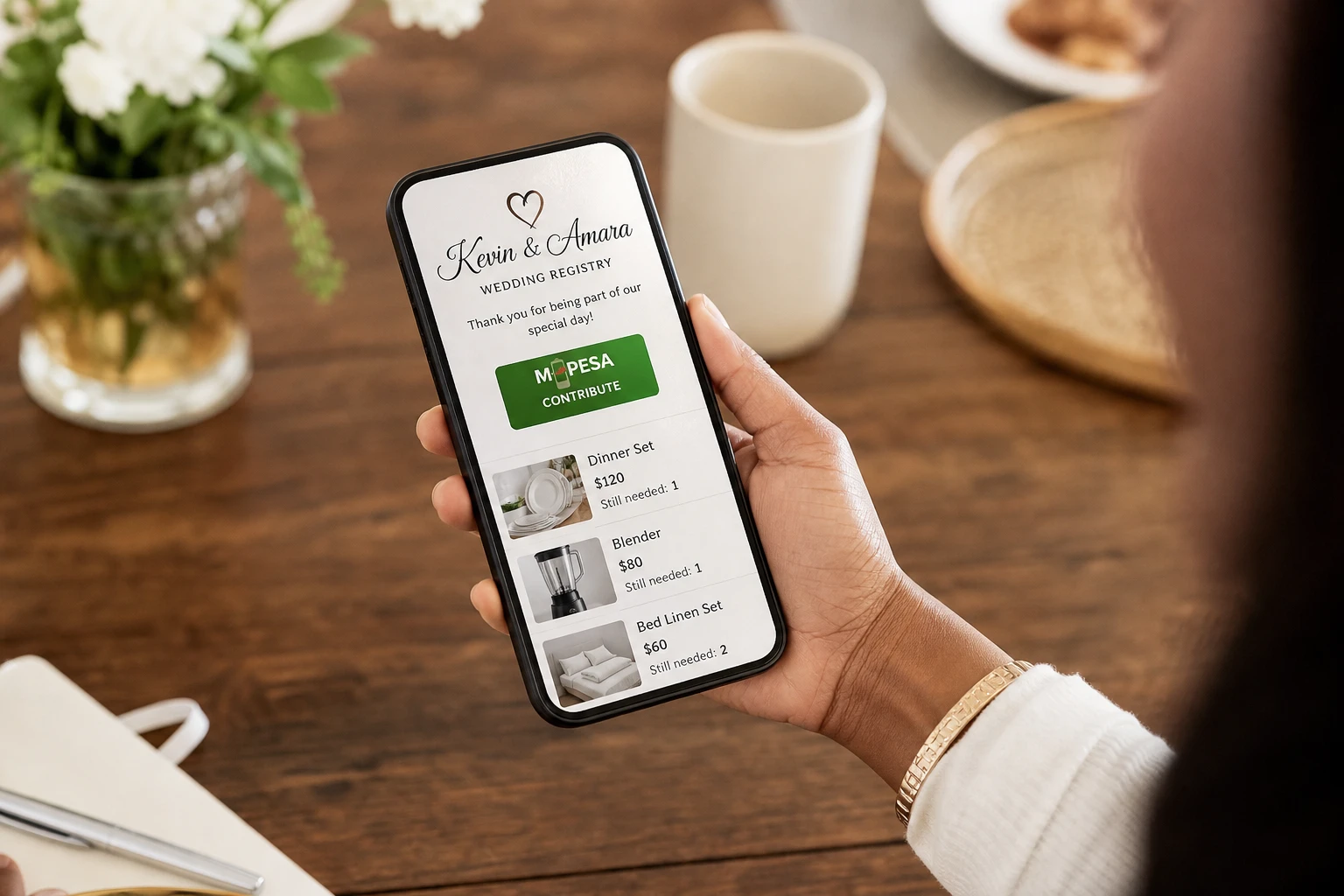
Open The Knot, Zola, WeddingWire, or Joy and navigate to the registry section. You will find integrations with Amazon, Crate & Barrel, Williams Sonoma, Pottery Barn, and dozens of other US retailers. You will find cash fund options processed through US bank accounts. You will find gift tracking dashboards, thank-you list management, and completion discounts.
What you will not find is an M-Pesa integration. Not one of the major international platforms supports it.
This is not a minor gap. For a Kenyan couple, M-Pesa is not an alternative payment method — it is the payment method. It is how most guests will want to contribute. It is faster, more familiar, and more accessible than any international payment alternative. Asking Kenyan guests to contribute via credit card or international bank transfer is asking them to do something many of them have never done, to pay fees they did not expect, and to navigate interfaces in a language designed for a different financial system.
Most will not do it. They will either not contribute at all, or they will call you and ask for your M-Pesa number — which is exactly what you were trying to avoid by setting up a registry in the first place.
How Kenyan Wedding Gift Culture Actually Works
To understand why the international registry model fails, it helps to understand how gifts work at Kenyan weddings.
Cash contributions are the norm. Rather than purchasing items from a registry list, most guests in Kenya give cash — either directly at the event, or in advance via M-Pesa. Harambee-style collective contributions are common, where groups of colleagues, relatives, or friends pool money together and present it as a group gift.
The practical question guests ask is not "what item should I buy?" — it is "how do I send money?" and the answer they expect is: M-Pesa. Specifically, they want a Paybill number, a till number, or a personal M-Pesa number with a reference or account name so their contribution is identifiable.
An international registry that lists home goods from US retailers and processes payments in USD does not answer the question Kenyan guests are actually asking.
What a Kenyan-Appropriate Registry Looks Like
The feature Kenyan couples actually need is simple:
- A dedicated registry page on their wedding website
- Clear display of their M-Pesa details (Paybill, till number, or personal number)
- A reference or account name for contributors to use
- Optional: a list of specific things contributions are going toward (honeymoon fund, home fund, a specific appliance)
This is not technically complex. It is a display feature — showing the information guests need to send money the way they already know how to.
Harusi Hub includes this as a standard registry feature. You add your M-Pesa details, set up contribution categories if you want them, and the registry page shows guests exactly where and how to contribute. No account creation required from the guest side. No currency conversion. No international payment friction.
For a broader look at wedding registry options in Kenya, see best wedding registries Kenya and wedding gift registry M-Pesa.
The International Platform Workaround Problem
Some couples try to work around the M-Pesa gap on international platforms. The common approaches are:
Adding M-Pesa details in a text field on the website. This works, but it is fragmented — the registry page lists retailers and cash funds, and the M-Pesa details are buried in a text section somewhere else on the site. Guests who navigate to the registry section find something that does not apply to them and have to look elsewhere.
Using the cash fund feature. Some platforms allow a cash fund where guests contribute via credit card or PayPal. The money then routes to a linked bank account. For Kenyan guests who do not have international credit cards or PayPal accounts, this is not accessible. For those who do, there are conversion fees and transfer delays.
Skipping the online registry entirely. Many Kenyan couples find that the international registry tools are so misaligned with their needs that they abandon the idea of a registry page and just send their M-Pesa number via WhatsApp when guests ask. This works, but it means the wedding website is not doing the job a registry feature should do.
None of these workarounds are as clean as a platform that integrates M-Pesa natively.
Setting Up an M-Pesa Registry on Harusi Hub
The process is straightforward:
- Navigate to your registry page editor in Harusi Hub
- Add your M-Pesa details — Paybill number (if applicable), till number, or personal number
- Add contribution categories if you want to show guests what their contributions go toward (e.g., "Honeymoon Fund," "Home Appliances," "Kitchen Setup")
- Set a privacy level — you can choose whether to display a contribution total or keep it private
Guests who visit your registry page see a clear, uncluttered display of your M-Pesa information and any contribution categories. They can contribute from their M-Pesa app in under a minute.
For the detailed walkthrough, see tutorial registry page editor.
The M-Pesa Integration Gap Is Not Closing
It is worth being direct about why international platforms do not support M-Pesa: they are building for markets where the feature generates revenue for them. Stripe, PayPal, and retail registry commissions generate revenue. Supporting M-Pesa in Kenya does not fit that model.
This is not about to change. The major international platforms will continue to optimize for their primary markets — the US, UK, and Western Europe — where their business models make sense. M-Pesa support will not appear on The Knot or Zola's product roadmap in any near-term timeframe.
For Kenyan couples, this means the choice is binary: use a platform that was built with M-Pesa in mind from the start, or work around the gap on a platform that was not.
Wedding website M-Pesa integration has a fuller analysis of how M-Pesa fits into the wedding website ecosystem.
Beyond the Registry: Why M-Pesa Matters for the Whole Platform
The M-Pesa registry gap is the most visible symptom of a broader issue: international wedding platforms were not built for the Kenyan financial system.
M-Pesa is not just a registry tool. It is how vendors get paid. It is how contributions are collected before the wedding. It is how the couple's planning budget is managed. A wedding platform that is truly built for Kenya needs to understand M-Pesa as a foundational part of the financial ecosystem, not as an afterthought.
Harusi Hub was designed with this understanding. The registry feature is one part of a broader approach to building a platform that actually fits the Kenyan wedding context.
Show your guests exactly how to contribute via M-Pesa
A registry page that works for Kenyan guests. Set up your M-Pesa details in minutes, free.
Set Up Your M-Pesa Registry