
Wedding Website Builders with M-Pesa Integration (Only One Exists)
Which wedding website builders integrate M-Pesa? Let's be direct: only one does. Here's why it matters and what everyone else offers as a workaround.
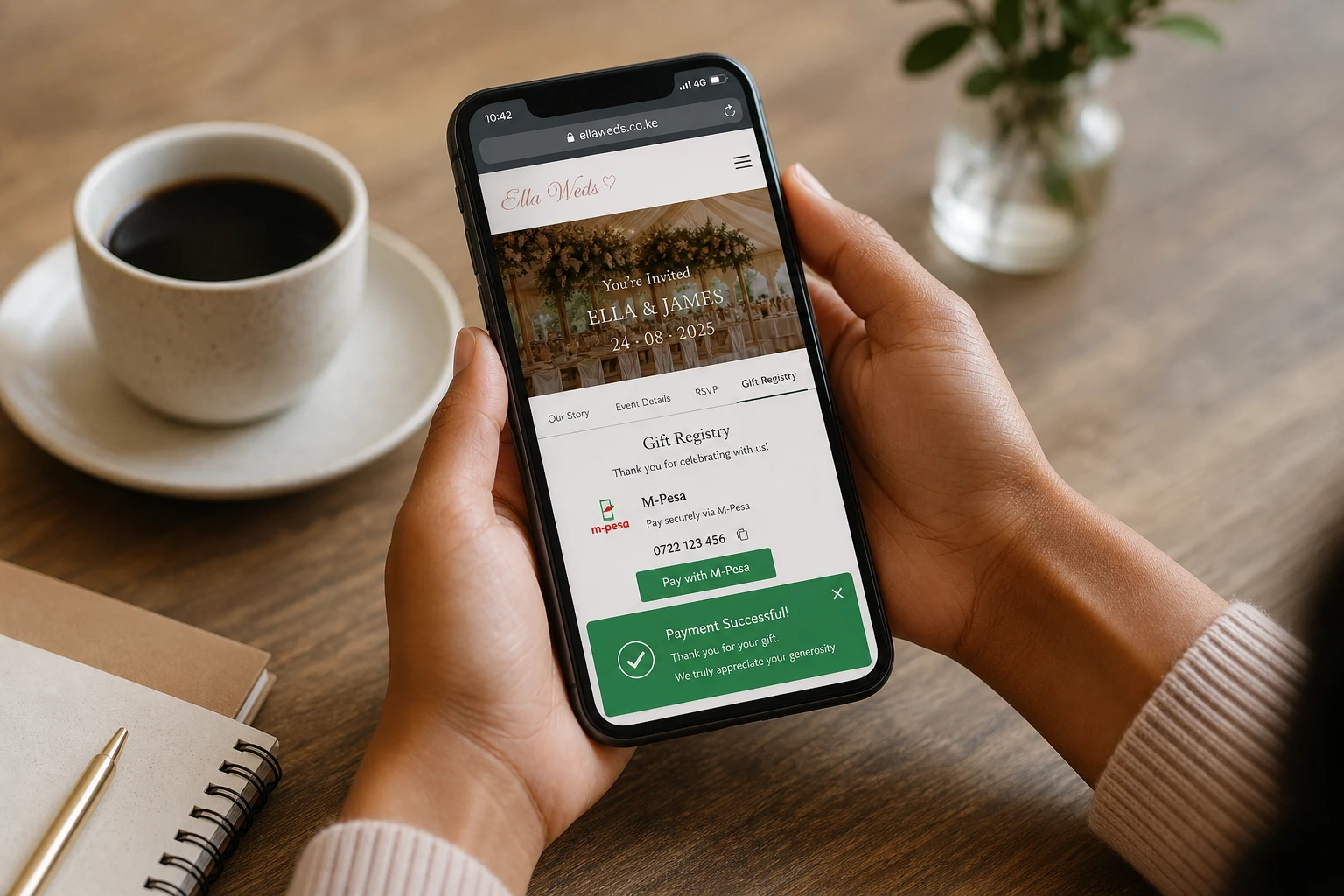
Let's be direct: one wedding website builder integrates M-Pesa. That platform is Harusi Hub. Every other major wedding website builder — Zola, Joy, The Knot, Minted, Wix, Squarespace — does not.
This isn't a minor feature gap. M-Pesa is the dominant payment method in Kenya, used by over 30 million people for everyday transactions including gifts, contributions, and event-related payments. A wedding registry that doesn't accept M-Pesa is not functional for a Kenyan wedding.
This article explains why the gap exists, what the workarounds are, and whether they are actually workable.
Why No One Else Integrates M-Pesa
The major wedding platforms are US and UK companies. Their business model typically involves taking a percentage of registry transactions or vendor bookings — which means their payment infrastructure is built around credit cards, US bank accounts, and US/UK retail partnerships.
M-Pesa integration requires a Safaricom developer account, a Kenya-registered business, and a local M-Pesa paybill or merchant API. For a company based in San Francisco or London, this is not a trivial addition. It requires a local entity, local compliance, and ongoing maintenance of the Safaricom API integration.
The market incentive has not yet been large enough to motivate US platforms to build this. Harusi Hub, being a Kenya-founded company, built the M-Pesa integration as a core feature because it is foundational to the product's usefulness in its home market.
What M-Pesa Integration Actually Enables
On Harusi Hub, M-Pesa integration covers three distinct use cases:
1. Gift registry contributions. Guests can contribute to specific registry items or general gift funds by paying via M-Pesa directly from the wedding website. No credit card, no international payment gateway, no account required from the guest. The couple receives contributions to their M-Pesa registered to the platform.
2. Cash fund goals. Couples can set up named funds (honeymoon, furniture, house deposit) with target amounts. Guests contribute via M-Pesa to specific funds. The couple can see which funds are fully funded, which are partially funded, and who contributed what.
3. Payment tracking. The budget tracker logs M-Pesa payments made to vendors — you can record a vendor payment, note the transaction reference, and track what's been paid vs outstanding.
These three use cases cover the vast majority of financial transactions in a Kenyan wedding.
The Workarounds Other Platforms Rely On
When a couple uses Zola, Joy, or The Knot for their wedding website and wants M-Pesa for their registry, the workaround is always some variation of the same thing: embed an M-Pesa number on the website and ask guests to send money manually.
This looks like:
- A text section on the wedding website with the M-Pesa Paybill/till number and instructions
- A note asking guests to use their name as the reference
- Manual tracking in a spreadsheet of who sent what
This workaround is not broken — it works. But it has real costs:
- No structured gift list. Guests can't see specific items or funds to contribute toward. Everything goes into one pool.
- Manual reconciliation. You track contributions by checking your M-Pesa statement and matching names to your guest list. At 200+ guests, this is hours of work.
- No automated acknowledgement. The platform can't send a thank-you or confirmation because it has no visibility into the M-Pesa transaction.
- Inaccurate registry status. Your wedding website shows registry items as "unpurchased" even if they've been paid for, because the platform has no connection to the M-Pesa transactions.
For couples who are comfortable with manual reconciliation and don't mind a less structured registry, this workaround is acceptable. For couples who want the registry to function properly — tracking contributions, showing funded status, and integrating with the overall planning dashboard — it's a significant limitation.
Platform-by-Platform Review
Harusi Hub — Native M-Pesa Integration
M-Pesa is integrated at the API level. Guests pay via M-Pesa from the wedding website. Contributions are tracked in real time. No workaround required.
What's included:
- M-Pesa payment for individual registry items
- M-Pesa contributions to named cash funds
- Real-time contribution tracking per item/fund
- Integrated with guest list (you can see which guests contributed)
- Budget tracker logs M-Pesa vendor payments with transaction references
Assessment: The only platform that solves this problem without a workaround. Full stop.
Zola — No M-Pesa
Zola's registry is built around US retail partnerships and a cash registry system that pays out to a US bank account. No M-Pesa integration exists or is planned.
Workaround: Add a text section to your Zola website with your M-Pesa number. Reconcile manually.
Assessment: The Zola website builder is genuinely excellent. If you want Zola's design quality and are comfortable with manual M-Pesa tracking, using Zola for the website and running M-Pesa separately is a reasonable choice. Don't expect Zola's registry to do anything useful for a Kenyan wedding.
See also: Zola for Kenyan Couples — Full Review
Joy — No M-Pesa
Same situation as Zola. Joy's registry and cash funds are US-payment-infrastructure-based.
Workaround: Same as Zola — embed M-Pesa number on the website.
Assessment: Joy's mobile experience is among the best in the category. The platform is well-suited for the wedding website component if Harusi Hub's template selection doesn't meet your design needs.
See also: Joy for Kenyan Couples — Full Review
The Knot — No M-Pesa
The Knot's registry is entirely US retail. There is no cash fund option equivalent to Zola/Joy. M-Pesa is not integrated.
Assessment: Not recommended for Kenyan couples for registry purposes. The website builder works, but the platform offers no useful registry or payment functionality.
See also: The Knot for Kenyan Couples — Does It Work?
Wix / Squarespace (General Website Builders)
General website builders can be used to build a wedding website with full design flexibility. M-Pesa payment can be added through a third-party plugin or a manual till number display.
Wix M-Pesa: Wix has some payment integrations, but native M-Pesa is not available. Third-party integrations via Wix Payments or direct embed of M-Pesa details are possible.
Squarespace M-Pesa: Not available natively. Manual embed of payment details.
Assessment: Both platforms require significant setup compared to a purpose-built wedding website builder. If you're comfortable building websites, a Wix/Squarespace site with manually embedded M-Pesa details is possible. For most couples, this is more effort than it's worth compared to using Harusi Hub.
Feature Comparison: M-Pesa Functionality
| Platform | Native M-Pesa | Cash Registry | Registry Tracking | Workaround Required |
|---|---|---|---|---|
| Harusi Hub | Yes | Yes (named funds) | Yes (real-time) | No |
| Zola | No | Yes (USD only) | Partial | Yes |
| Joy | No | Yes (USD only) | Partial | Yes |
| The Knot | No | No | No | Yes |
| Wix | No | Via plugin | No | Yes |
| Squarespace | No | Via plugin | No | Yes |
The Bottom Line
If M-Pesa integration for your wedding registry is a requirement — and for most Kenyan weddings, it should be — Harusi Hub is the only platform that delivers it natively. Every other option requires a manual workaround that introduces reconciliation work and creates a gap between your website registry and actual contributions.
Use Harusi Hub for your registry. If you prefer another platform's design aesthetic for your wedding website, you can use both — but don't expect any other platform's registry to function properly in the Kenyan context.
Set up your M-Pesa-integrated wedding registry with Harusi Hub →
Related reading: