
Wedding Website with Phone RSVP: Why Email-Only Platforms Fail in Kenya
If your wedding website collects RSVPs by email, most of your Kenyan guests won't respond. Here's why phone-based RSVPs work better and how to set them up.
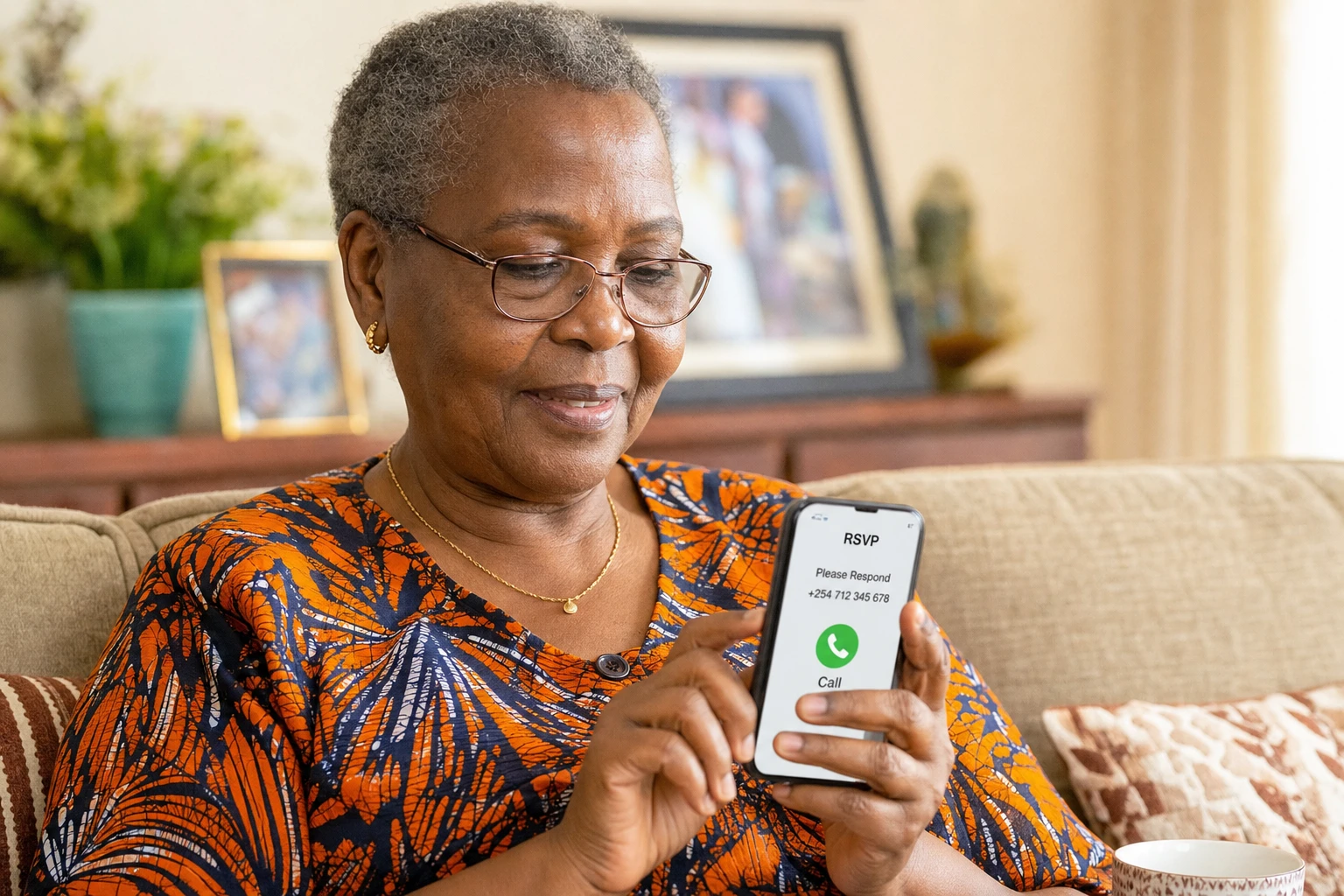
Here is a scenario that plays out constantly among Kenyan couples who use international wedding platforms: they spend time setting up a beautiful wedding website, add all their event details, turn on the RSVP feature, and send the link to their guests. A week later, they have responses from about half the people they expected — mostly younger relatives who are digitally comfortable. The other half have not responded.
They are not ignoring you. They just did not complete the RSVP form.
The problem is not the guests. The problem is the assumption the platform made about how guests communicate.
Why Email-Based RSVPs Fail for Many Kenyan Guests
Most major wedding platforms — The Knot, Zola, WeddingWire, Joy — anchor their RSVP systems around email. Guests need to:
- Have an email address
- Check it regularly
- Open the invitation email
- Click through to the wedding website
- Complete a form
Each of those steps is a drop-off point. In the United States, where email is still the dominant professional communication channel, this chain works reasonably well. In Kenya, step 2 is where it breaks down for a significant portion of guest lists.
WhatsApp is the primary digital communication channel for most Kenyan families. Phone calls are how people confirm important things. Email may exist as an account — many people have Gmail — but it is not the inbox that gets checked daily. For some guests, particularly older family members and those in areas with limited smartphone penetration, email is not a practical contact channel at all.
The result: your wedding website collects RSVPs from the subset of guests who engage with email. Everyone else requires manual follow-up — phone calls, WhatsApp messages, conversations through mutual relatives. The platform was supposed to reduce this work. Instead, it only handles part of it.
See best wedding RSVP tools phone for a comparison of platforms that handle this differently.
What Phone-Based RSVP Means in Practice
A phone-based RSVP system reverses the assumption. Instead of asking guests to have and use an email address, it asks for what they already have and use: their phone number.
In practical terms, this means:
- Guests confirm attendance by providing their phone number (which they already know by heart)
- No email required to submit an RSVP
- The wedding website is shareable via WhatsApp link — guests tap the link, confirm attendance, done
- The couple can also add guest responses manually on behalf of guests who called or responded via a third party
This is how RSVP should work in a mobile-first, WhatsApp-primary communication culture.
Harusi Hub collects RSVPs by phone number. The flow is optimized for the Kenyan guest experience, including guests who are comfortable clicking a WhatsApp link but less comfortable with formal web forms that require account creation or email verification.
The Guest Experience Matters More Than the Couple Experience
When couples choose a wedding website platform, they often focus on the couple experience: how easy is it to set up, how do the templates look, what features does it include. These are reasonable criteria.
But the RSVP system is primarily a guest experience. The couple touches it once, when setting it up. Guests touch it every time they need to respond. If the guest experience creates friction — and requiring email in a WhatsApp-first market creates significant friction — your response rates suffer and your workload increases.
A wedding website that looks perfect but collects incomplete RSVPs is worse than a simpler platform that actually gets responses from your entire guest list.
Setting Up Phone RSVPs on Harusi Hub
The process is straightforward:
- Create your wedding website on Harusi Hub
- Navigate to RSVP settings
- Configure guest confirmation to accept phone numbers as the primary contact field
- Share your wedding website link via WhatsApp to your guest list
Guests who click the link will be asked to confirm their name and phone number — information they have memorized — and submit. No account creation, no email required.
You can also manually add guests who respond through other channels: a phone call, a message through a mutual relative, or a direct WhatsApp message to you. The guest list stays unified in one place regardless of how each individual guest responded.
See tutorial RSVP settings for the step-by-step configuration guide.
How This Compares to the Alternatives
Email-only platforms (The Knot, Zola, Joy, WeddingWire): Functional for guests who use email. Incomplete for the portion of your Kenyan guest list who do not. Requires manual follow-up to fill the gap.
WhatsApp broadcast list: Many couples manage RSVPs entirely through WhatsApp — send a broadcast message, track responses in the chat. This works at small scale but becomes difficult to manage above 50-60 guests. You are manually reading messages, maintaining a separate spreadsheet, and chasing non-responders through the same channel you sent the initial message.
Paper invitation with reply card: Traditional, reliable, and culturally appropriate. The limitation is operational: collecting, counting, and managing physical reply cards is slow and error-prone for larger guest lists. Lost reply cards happen.
Harusi Hub phone RSVP: Guests respond with their phone number via a WhatsApp-shareable link. Responses are tracked automatically. You see RSVP status for each guest in real time. Manual entry is available for guests who respond outside the system.
For Diaspora Couples
This consideration is particularly important for diaspora couples planning a Kenya wedding from abroad. If you are coordinating from London, Toronto, or Dubai, you cannot chase non-respondents with phone calls the same way you could if you were on the ground. Your guests are primarily reachable via WhatsApp, and your RSVP system needs to work with that reality.
See wedding website for diaspora couples planning Kenya weddings for a broader look at how the platform serves couples abroad.
The Bottom Line
Email-based RSVP systems were designed for markets where email is the dominant communication channel. Kenya is not one of those markets. A wedding website platform that collects RSVPs by phone number — the contact point your guests already use — will deliver meaningfully better response rates and reduce your manual follow-up burden.
This is not a minor convenience feature. For a Kenyan wedding with 150-300 guests, the difference between an email-based and phone-based RSVP system can mean dozens of hours of follow-up work.
Collect RSVPs the way your guests actually communicate
Phone-number RSVPs, WhatsApp-shareable links, real-time tracking. Free to start.
Start Collecting RSVPs