
Wedding Website Builder Comparison: Africa vs US Platforms (2026)
A data-driven comparison of African and US wedding website builders across the features that matter most for African couples planning weddings in 2026.
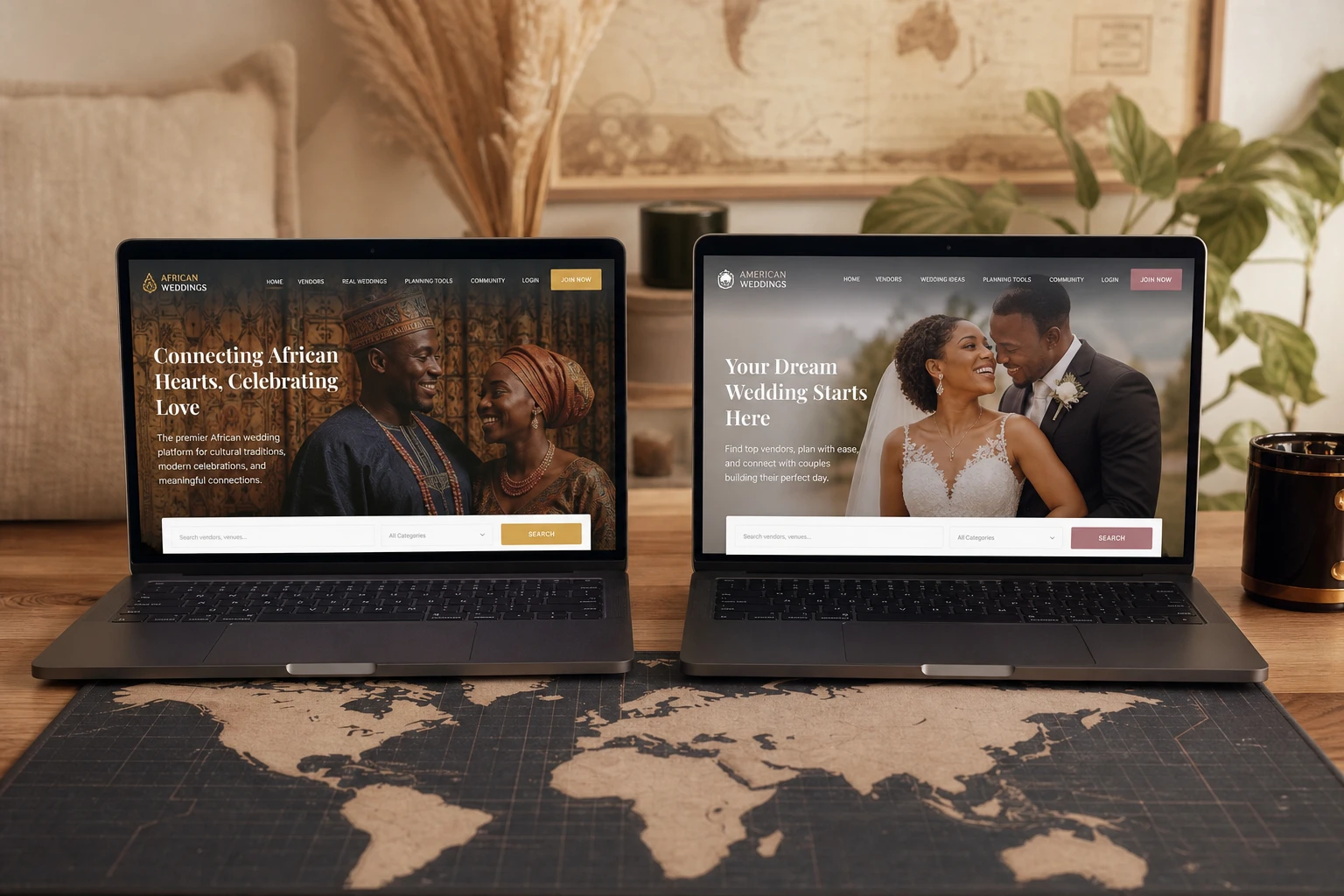
The wedding platform market is dominated by US companies. The Knot, Zola, WeddingWire, Joy, and Minted collectively serve millions of US couples every year. They have refined their products through years of iteration, large marketing budgets, and deep understanding of the American wedding industry.
African couples, particularly those in East and West Africa, have two choices: use a US platform and work around its structural limitations, or use an African platform built for their market. This comparison examines both options across the features that matter most, using data and specific examples rather than broad claims.
Methodology
This comparison evaluates platforms across eight criteria:
- RSVP collection method
- Mobile money / M-Pesa support
- Multi-event wedding support
- Local vendor integration
- Guest list management
- Free tier availability and scope
- Template design quality
- Mobile experience for guests
Each criterion is assessed for how well it serves African couples specifically — not how well it serves the market the platform was designed for.
The Platforms
African Platforms
Harusi Hub — Kenya/East Africa focus
Inawo — Nigeria/West Africa focus
US Platforms
The Knot, Zola, WeddingWire, Joy, Minted
Criterion 1: RSVP Collection Method
This is the most consequential criterion for African couples. In most African markets, including Kenya, Nigeria, Ghana, and Uganda, phone numbers are the primary contact method. Email engagement rates for non-work communication are significantly lower than in the US and Western Europe.
| Platform | Method | African Guest Accessibility |
|---|---|---|
| Harusi Hub | Phone number | High |
| Inawo | Phone + email | High |
| The Knot | Email only | Moderate |
| Zola | Email only | Moderate |
| WeddingWire | Email only | Moderate |
| Joy | Email only | Moderate |
| Minted | Email only | Moderate |
"Moderate" here means that a significant portion of African guest lists — particularly older relatives and guests in areas with lower smartphone penetration — will not complete email-based RSVP flows without manual follow-up from the couple.
The practical difference: couples using email-only platforms for African guest lists consistently report needing significant manual follow-up to fill in the RSVPs the platform did not capture. Couples using phone-based systems report more complete initial response rates.
See wedding website phone RSVP Kenya for analysis specific to the Kenyan market.
Criterion 2: Mobile Money Support
Mobile money — M-Pesa in East Africa, MTN Mobile Money and Airtel Money in West Africa — is the dominant payment method for person-to-person transfers across the continent.
| Platform | Mobile Money Support | Notes |
|---|---|---|
| Harusi Hub | Yes (M-Pesa native) | Built-in registry display for M-Pesa details |
| Inawo | Partial | Optimized for Nigerian payment rails; M-Pesa limited |
| The Knot | No | US bank/credit card only |
| Zola | No | US bank/credit card only |
| WeddingWire | No | US bank/credit card only |
| Joy | No | US bank/credit card only |
| Minted | No | US bank/credit card only |
No major US platform has integrated mobile money support as of 2026. This is not an oversight — it reflects the US-centric business model of these platforms. Mobile money integration for African markets does not fit the revenue model that US platforms are optimized for.
For African couples, this means registry contributions must either be handled outside the platform (couples share M-Pesa details separately) or guests are expected to use international payment methods that most do not have.
See M-Pesa wedding registry feature for the full analysis.
Criterion 3: Multi-Event Wedding Support
African weddings — particularly in East Africa, West Africa, and Southern Africa — frequently involve multiple ceremonies with distinct purposes, guest lists, and logistics.
| Platform | Multi-Event Support | Notes |
|---|---|---|
| Harusi Hub | Yes (full) | Separate pages, guest lists, RSVP flows per event |
| Inawo | Partial | Multi-event support, limited per-event filtering |
| The Knot | Workarounds only | Secondary events exist but share the primary guest list |
| Zola | Limited | Multi-event structure is not designed for distinct ceremonies |
| WeddingWire | Limited | Similar to The Knot |
| Joy | Limited | Single-event focus with secondary event additions |
| Minted | No | Single-event structure |
The distinction matters: US platforms allow you to add "secondary events" like rehearsal dinners and engagement parties, but these are treated as satellites around one central wedding. African multi-ceremony weddings often have events with distinct, separate guest lists — a ruracio guest list is not a subset of the full wedding guest list, it is a different list with different criteria. That structural distinction is what no US platform handles well.
See Can you plan a ruracio on The Knot? for a specific example of where this limitation creates problems.
Criterion 4: Local Vendor Integration
| Platform | Local Vendor Directory | Notes |
|---|---|---|
| Harusi Hub | Developing | Curated recommendations, growing |
| Inawo | Nigeria-focused | Limited Kenya coverage |
| The Knot | US only | No African vendors |
| Zola | US only | No African vendors |
| WeddingWire | US only | No African vendors |
| Joy | None | No vendor directory |
| Minted | None | No vendor directory |
No US platform has local vendor information for African markets. This is perhaps the starkest gap: the vendor discovery that makes platforms like The Knot and WeddingWire valuable in the US provides zero utility to a couple in Nairobi or Lagos.
African couples find vendors through Instagram, personal referrals, WhatsApp communities, and word of mouth. No platform currently provides meaningful local vendor discovery for East Africa, though Harusi Hub is building in this direction.
See WeddingWire alternative Kenya for more on the vendor discovery gap.
Criterion 5: Free Tier Scope
| Platform | Free Tier | Key Limitations |
|---|---|---|
| Harusi Hub | Full features | None identified for core features |
| Inawo | Yes | Some premium features behind paywall |
| The Knot | Limited | Premium templates, some features paid |
| Zola | Limited | Registry features, some templates paid |
| WeddingWire | Yes | Some features limited |
| Joy | Limited | Premium features behind paywall |
| Minted | No | Paid platform from entry |
Criterion 6: Template Design Quality
This is where US platforms have a genuine advantage. Zola in particular has invested heavily in design, and its templates are visually excellent. Joy's design is also strong.
Harusi Hub's templates are clean and functional, appropriate for the wedding context, and load efficiently on mobile connections. They are not as visually varied or polished as Zola's at the premium end.
Inawo's design is modern and competitive with the better US platforms.
Honest assessment: Couples prioritizing premium design aesthetics will find Zola and Joy more visually impressive than either African platform. This is a real tradeoff. The question is whether visual polish outweighs functional fit for your specific wedding context.
Criterion 7: Mobile Guest Experience
Given that most African wedding guests access links via mobile rather than desktop, mobile performance matters significantly.
| Platform | Mobile Guest Experience | Notes |
|---|---|---|
| Harusi Hub | Optimized | Designed for mobile-first guest access |
| Inawo | Good | Mobile-responsive design |
| The Knot | Good | Well-funded mobile optimization |
| Zola | Excellent | Strong mobile UX investment |
| WeddingWire | Good | Adequate mobile experience |
| Joy | Good | Clean mobile experience |
| Minted | Adequate | Less mobile-optimized than competitors |
Overall Assessment
The question is not which platform has the most features. It is which platform best serves African couples for the specific job of planning an African wedding.
On that question, the answer is clear: African platforms — Harusi Hub for East Africa, Inawo for West Africa — serve African couples better because they were built with African wedding realities as their foundation.
US platforms can be used by African couples with workarounds: sharing M-Pesa details in a text section, manually following up on email RSVPs, using the secondary event structure for multi-ceremony weddings. But workarounds are friction. A platform that requires no workarounds for your context will serve you better throughout your planning process.
For East African couples: Harusi Hub
For West African couples: Inawo
For couples who prioritize design above all else: Zola, with the awareness that the RSVP and registry features will require workarounds
For the broadest overview, see best wedding website builders Africa and best free wedding website builders Kenya.
Try the platform built for African weddings
Phone RSVPs, M-Pesa registry, multi-ceremony support. Free to start, no workarounds needed.
Create Your Free Wedding Website