
How to Brief Your Wedding Photographer (Shot List + Timeline Template)
A practical guide to briefing your wedding photographer in Kenya — with a complete shot list template, timeline structure, and tips for a smooth day.
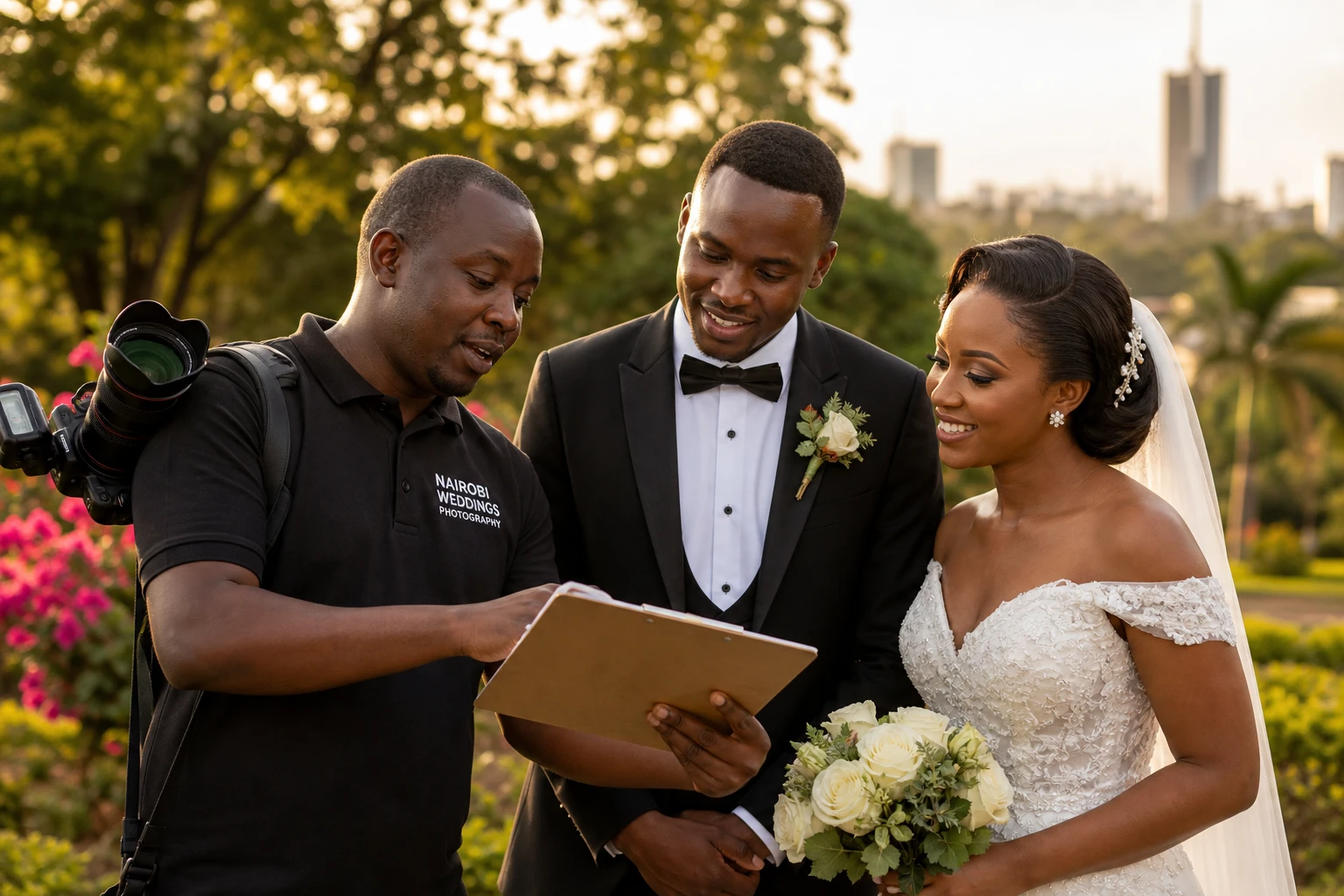
You have found your photographer. You love their work. Now comes the step most couples skip — the briefing conversation that determines whether your photographer walks into your wedding prepared or improvising.
A thorough pre-wedding brief is not about controlling your photographer. It is about giving them the information they need to do their best work. A photographer who knows your family structure, understands which moments matter most, has a copy of your timeline, and knows what you absolutely do not want is a photographer who will deliver.
This guide gives you a complete framework: what to cover in your briefing meeting, a shot list template, a timeline structure, and the specific things Kenyan couples often forget to discuss.
When to Do the Briefing
Schedule your main briefing meeting 4-6 weeks before the wedding. Earlier than this and details may change; later and the photographer has less time to prepare.
Before the meeting, send your photographer:
- The venue address and your contact person there
- Your wedding day timeline (use the template below)
- The bride and groom's full names as they should appear on any materials
- A note about your photography style preference (see wedding photography styles explained if you are still deciding)
The Briefing Meeting: What to Cover
1. Your Style Priorities
Tell your photographer explicitly what matters most to you:
- "We want natural, candid moments first. Formals are secondary."
- "Family formals are very important to us. We have a large extended family."
- "We love editorial-style couple portraits. We want to allocate real time for them."
Do not leave this implied. Even an excellent photographer cannot read your mind.
2. Family Structure and Key People
Write out your family structure before the meeting. Photographers need to know:
- Who are the parents? Are any divorced, separated, or remarried? This affects how group portraits are arranged.
- Who are the siblings and their partners?
- Are there any family sensitivities to be aware of? (Feuding relatives who should not be photographed together)
- Who are the grandparents? These are priority subjects — grandparents tire quickly and should be photographed early.
- Are there any guests with mobility limitations or health conditions that affect positioning?
3. Absolute Must-Have Shots
This is your personal shot list — moments that are non-negotiable regardless of anything else that happens. Be specific:
- "My grandmother and I have a specific tradition where she pins the corsage. We need that captured."
- "My mother helped make my dress. I want a moment of her seeing me in it for the first time."
- "The four of us brothers together — this is the first time all four will be in the same country in six years."
Keep this list to 10-15 items. More than that and it stops being a priority list.
4. What You Do Not Want
Just as important as the must-haves:
- Unflattering angles (many brides specify this clearly)
- Guests you prefer not to be prominently featured
- Specific expressions or poses that feel unnatural to you
- Flash photography during the ceremony (check if your venue allows this)
5. Vendor Contacts
Your photographer needs:
- Venue coordinator name and number
- MC or event planner name and number
- Videographer name (so they can coordinate to avoid blocking each other)
- Hair and makeup artist contact (for coordinating getting-ready shots)
The Shot List Template
Use this as a starting point. Remove categories that do not apply, add specific moments from your family structure.
Pre-Ceremony (Getting Ready)
- Dress hanging or laid flat (detail shot)
- Rings, shoes, jewelry laid out together
- Bride with bridesmaids getting ready
- Bride's mother or significant family member helping with dress, veil, or jewelry
- Groom with groomsmen getting ready
- Groom seeing himself in the mirror (quiet moment)
- Father of the bride seeing bride for the first time
- First look (if planned) — bride and groom seeing each other before ceremony
- Bouquet and buttonhole detail shots
- Invitation, program, and stationery flat lay
Ceremony
- Groom's reaction as bride enters
- Bride walking down the aisle (from front, looking back)
- Father of the bride's expression during handoff
- Full altar scene (wide shot showing full setup)
- Ring exchange — close detail of hands
- First kiss
- Recessional — couple walking back down the aisle
- Confetti or petals throw (coordinate with MC on timing)
- Guests cheering or clapping
Family Formals (Group Portraits)
Prepare a named list in this format — your photographer can work through it systematically:
- Bride + Groom + Bride's parents
- Bride + Groom + Groom's parents
- Bride + Groom + both sets of parents together
- Bride + Groom + siblings (bride's side)
- Bride + Groom + siblings (groom's side)
- Bride + Groom + grandparents (prioritize — grandparents first)
- Bride + Groom + full wedding party
- Bridesmaids only
- Groomsmen only
- [Add any additional combinations that matter to your family]
Tip: Assign one person from each family (a sibling or cousin) to be the "family wrangler" during formals. Their job is to gather the right people quickly so your photographer does not have to chase anyone.
Realistic timing: Allow 5 minutes per combination. 10 combinations = 50 minutes minimum. Build this into your day schedule.
Couple Portraits
- Full length together (several locations if venue allows)
- Walking together (candid movement)
- Laughing together (ask your photographer to make you laugh — they have tricks)
- Close-up faces and details
- Golden hour portraits (if timing allows — schedule this)
- Ring on hand detail
Reception
- Venue and table setup before guests enter
- Centerpiece details
- Wedding cake detail
- Couple's first entrance to reception
- First dance (wide establishing shot + close details)
- Parent dances
- Speeches (speaker and reaction shots simultaneously — ask if they have a second shooter)
- Cake cutting
- Bouquet toss if planned
- Open dancing: candid moments
- Sunset or end-of-night couple shot
Details (Throughout the Day)
- Wedding rings
- Flowers and bouquet
- Venue exterior and entrance
- Signage
- Table settings
- Favours
- Guest book and pen
The Timeline Template
Share this structure with your photographer and adjust times for your actual day.
| Time | Event | Notes |
|---|---|---|
| 7:00 AM | Photographer arrives at bride's preparation location | Address + contact |
| 7:00–9:30 AM | Getting ready coverage (bride's side) | Dress on at 9:15 |
| 9:30 AM | Photographer moves to groom's location | Address + contact |
| 9:30–11:00 AM | Getting ready coverage (groom's side) | |
| 11:00 AM | Photographer arrives at venue | |
| 11:00–11:30 AM | Venue detail shots (before guests arrive) | |
| 11:30 AM | Guests begin arriving | |
| 12:00 PM | Ceremony begins | |
| 1:00 PM | Ceremony ends | Adjust for your actual length |
| 1:00–2:00 PM | Family formals | List of combinations provided |
| 2:00–3:00 PM | Cocktail hour — candid guest coverage | |
| 2:30–3:00 PM | Couple portraits | Location: [specify] |
| 3:00 PM | Reception begins | |
| 5:30 PM | Golden hour couple portraits (if planned) | 20-30 minutes max |
| 8:00–9:00 PM | Photographer departs | Confirm coverage end time |
Important: Confirm your photographer's end time before signing the contract. Standard packages in Kenya typically cover 8-10 hours. Evening events that run late may require overtime charges.
The Nairobi-Specific Things to Discuss
Traffic: If your ceremony and reception are at different venues, Nairobi traffic can add 30-60 minutes to your timeline. Your photographer needs to know about any location changes so they can build travel time into their plan.
Two shooters versus one: If your guest count is over 150 or your ceremony and reception are in different buildings at the same time, ask about a second shooter. Some Kenyan photographers offer this; others subcontract. Ask who the second shooter is and if you can see their work.
Indoor lighting: Many Kenyan reception venues have dim decorative lighting that is challenging to photograph in without flash. Ask your photographer how they handle this — do they bring additional lighting, or does their editing process handle it? Ask to see images from a similarly lit venue.
Delivery timeline: Ask explicitly when you will receive your edited images. Standard in Kenya ranges from 4 to 12 weeks. Get this in writing.
For the full vendor directory and to check photographer availability for your date, visit the Harusi Hub vendor directory. And use the wedding day schedule planner to build a shareable timeline your photographer can access directly.
Build and Share Your Wedding Day Timeline
Create a day-of schedule in Harusi Hub and share the link with your photographer, MC, and venue coordinator — everyone works from the same plan.
Build Your Day Schedule