
Wedding Photography Styles Explained: Documentary vs Traditional vs Editorial
A clear guide to the three main wedding photography styles — documentary, traditional, and editorial — so you can choose the right photographer for your day.
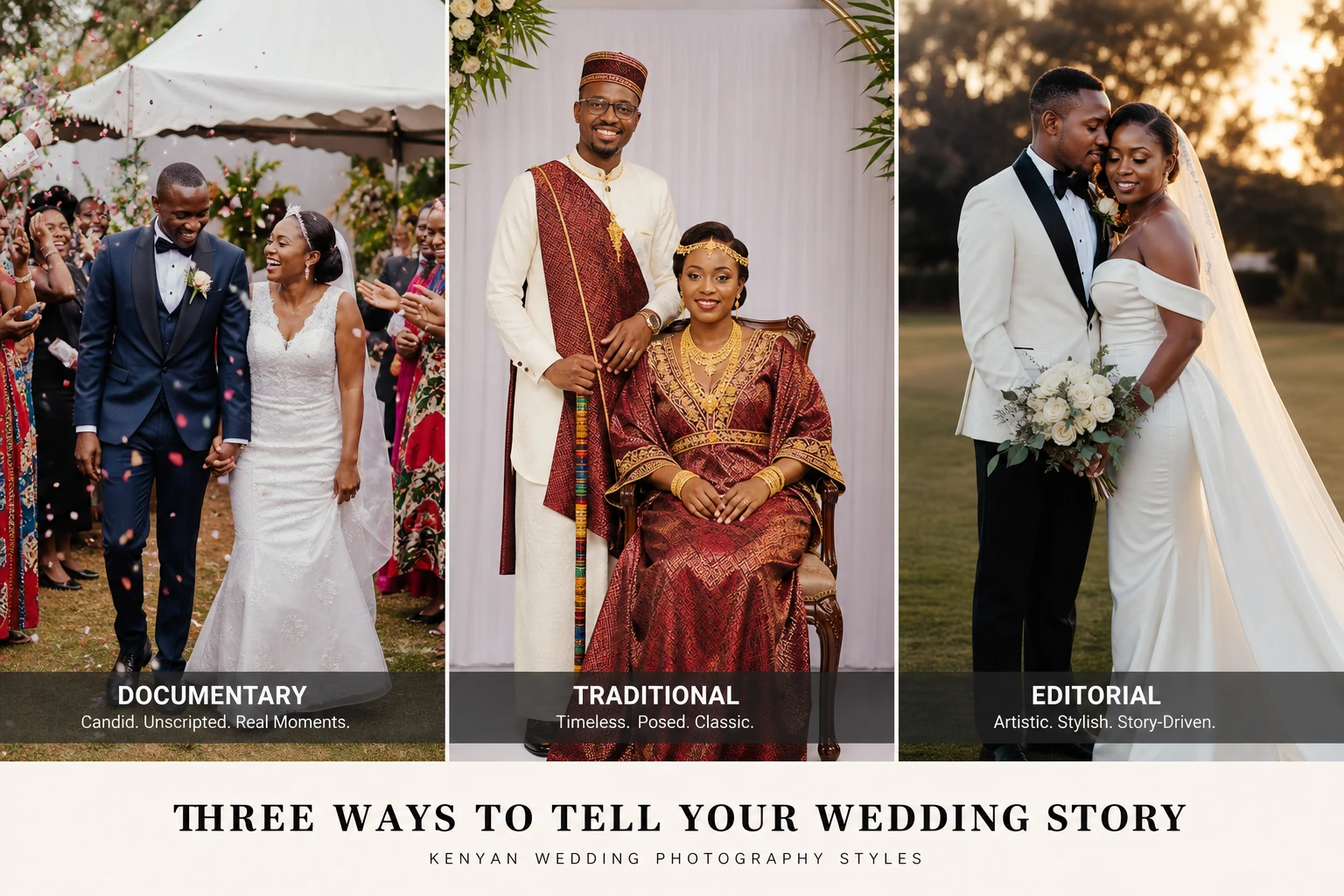
Wedding photography has never been more varied — or more confusing. Browse photographer portfolios in Nairobi and you will encounter terms like "photojournalistic," "fine art," "lifestyle," "editorial," and "classic." Many photographers use these terms interchangeably or combine them in ways that make comparison difficult.
This article cuts through the terminology. There are three core styles that underlie almost every wedding photographer's work: documentary, traditional, and editorial. Understanding what each one actually means — and what it looks like in practice — will help you choose a photographer whose work reflects what you actually want from your wedding images.
The Three Core Styles
Documentary (Also Called Photojournalistic)
Documentary wedding photography treats the wedding day as a news event to be captured, not staged. The photographer's job is to be present everywhere and visible nowhere — to observe and record moments as they unfold without interfering.
What the images look like:
- Candid expressions: a mother wiping a tear, the groom laughing with his groomsmen, a child dancing on the floor
- Natural, unposed group moments
- In-the-moment details: rings resting on the invitation, a bridesmaid fixing the veil, the first look
- Variable light — documentary photographers work in whatever light exists, which means indoor reception photos may have a moodier, darker quality than studio-lit alternatives
- Movement and imperfection: blurry edges, motion, real life
What you give up:
- Control. If your family did not gather for a natural group moment, there is no group photo.
- Consistency. The images depend heavily on what happened, not on a predetermined shot list.
- Traditional family formals. Documentary photographers typically do minimal posed group shots.
Who it suits: Couples who value authenticity above all else. Couples who tend to feel uncomfortable in front of a camera and want to simply live their day. Couples with a strong aversion to lengthy posed photo sessions.
In the Kenyan context: Documentary style is trending strongly upward in Nairobi, particularly among couples who have seen international work on Instagram and Pinterest. Older family members sometimes have mixed feelings — they may expect formal group portraits that a purely documentary approach does not prioritize. This is worth discussing openly with your photographer before the day.
Traditional (Also Called Classic or Formal)
Traditional wedding photography has a century-long history. It prioritizes posed, formal images that are composed for clarity, symmetry, and completeness. The goal is a comprehensive record of every important group and moment, executed with clean technique.
What the images look like:
- Full wedding party posed formally — everyone visible, looking at the camera, smiling
- Staged family portraits: parents, siblings, grandparents, each combination photographed
- Classic couple portraits with directed poses
- Even, flattering lighting — often supplemented with flash or studio lighting
- Consistent exposure and color across the gallery
What you give up:
- Spontaneity. The candid moments between posed shots are not the focus of this style.
- Efficiency. A comprehensive traditional shoot with multiple family combinations can take 1-2 hours of the reception.
- Narrative. The images document who was there, but may tell less about how it felt.
Who it suits: Couples with large extended families where every combination matters. Couples who want a clear, formal record of their day. Couples with parents or grandparents who have strong expectations for formal portraits. Couples who feel more comfortable with direction than open-ended candid photography.
In the Kenyan context: Traditional photography remains the dominant expectation at many Kenyan weddings, particularly for older generations and in communities where the wedding album is shared widely with relatives who were not present. It is a reliable, time-tested approach. The risk is that it can feel generic if the photographer executes it mechanically without personality.
Editorial (Also Called Fine Art or Fashion-Influenced)
Editorial wedding photography takes inspiration from fashion and magazine photography. Images are carefully composed, dramatically lit, and styled as if for a publication. The photographer works collaboratively with the couple to create images that are visually striking rather than simply documenting what happened.
What the images look like:
- Dramatic, cinematic lighting: golden hour backlighting, dark shadows, deliberate flares
- Magazine-quality couple portraits with intentional styling and direction
- Environmental portraits using architectural or landscape settings as strong visual elements
- A consistent visual aesthetic across the gallery — often a specific color grade or tone
- Strong composition: leading lines, symmetry, deliberate framing
What you give up:
- Naturalness. The images are crafted, not captured.
- Efficiency. Good editorial images require time — finding the right light, the right angle, repeating a pose until it works.
- Inclusivity. Editorial style prioritizes the most visually compelling subjects (usually the couple) over comprehensive family documentation.
Who it suits: Couples who value aesthetics strongly and are comfortable spending significant time in front of the camera. Couples with a strong visual identity for their wedding (clear color palette, styled decor, coordinated wedding party). Couples who plan to use their wedding images in design — on a website, as prints, as part of a brand.
In the Kenyan context: Editorial style has grown significantly with the rise of Kenyan wedding blogs and Instagram. It works particularly well at Nairobi's high-design venues (rooftop gardens, boutique properties, dramatic landscapes). It requires more investment in both photographer time and couple preparation. See our guide on top wedding photographers in Nairobi for photographers who specialize in this style.
Most Photographers Blend Styles
In practice, very few photographers work in a single style exclusively. Most good photographers move between documentary and traditional at minimum — capturing candid moments throughout the day while ensuring they complete the formal family portraits and key posed couple shots the couple and family expect.
When reviewing a photographer's portfolio, look for evidence of all the elements you want:
- If you want candid moments, find them in the portfolio. Do not assume they exist just because the photographer mentions "photojournalism" in their description.
- If you want formal family portraits, ask how many combinations they typically complete and how they manage the family during that session.
- If you want editorial images, look at how they handle natural environments and light, not just controlled studio settings.
Questions to Ask Based on Style Preference
If you lean documentary:
- How do you handle family formals for guests who expect them?
- What happens in low-light indoor reception venues?
- Can I see a full gallery from a recent wedding (not a highlights selection)?
If you lean traditional:
- Do you provide a standard shot list or can I customise it?
- How long do family formals typically take?
- How do you manage the group in those sessions efficiently?
If you lean editorial:
- How much couple portrait time do you typically schedule?
- Do you scout the venue before the wedding day?
- What time of day do you prefer for couple portraits and why?
For a full guide on briefing your photographer once you have selected your style, see how to brief your wedding photographer.
A Note on Cost
Photography style is not a reliable predictor of price in Kenya. Some documentary photographers charge more than traditional ones; some editorial photographers are newer to the industry and charge less. What matters more in pricing is experience, gear quality, deliverables (number of edited photos, album included or not, turnaround time), and reputation.
See how much does a wedding photographer cost in Kenya for a full breakdown of what to expect at different price points.
How to Choose
Ask yourself three questions:
1. What do I want to feel when I look at these images in ten years? Moved by the realness of the moment? Reassured that everyone was documented? Impressed by the visual beauty? Your answer reveals your core priority.
2. How much of the wedding day am I willing to spend on posed photography? More posed = more traditional. Less posed = more documentary. Editorial couple portraits require dedicated time separate from both.
3. What do my parents and family expect? This is a real consideration at many Kenyan weddings. If formal group portraits are important to your families, communicating this to your photographer before the day — and building the time for it into your schedule — avoids conflict and disappointment.
The right answer is not the same for every couple. The goal is to choose a photographer who genuinely excels at the style you want, not one who claims to do everything equally well.
Build Your Wedding Day Timeline
Once you know your photography style, build a day schedule that gives your photographer the time they need. The Harusi Hub day planner keeps your timeline shareable with your whole vendor team.
Build Your Day Schedule