
Writing Personal Wedding Vows: A Step-by-Step Guide for Kenyan Couples
Ready to write your own wedding vows but not sure where to start? This step-by-step guide walks Kenyan couples through every stage — from first draft to the aisle.
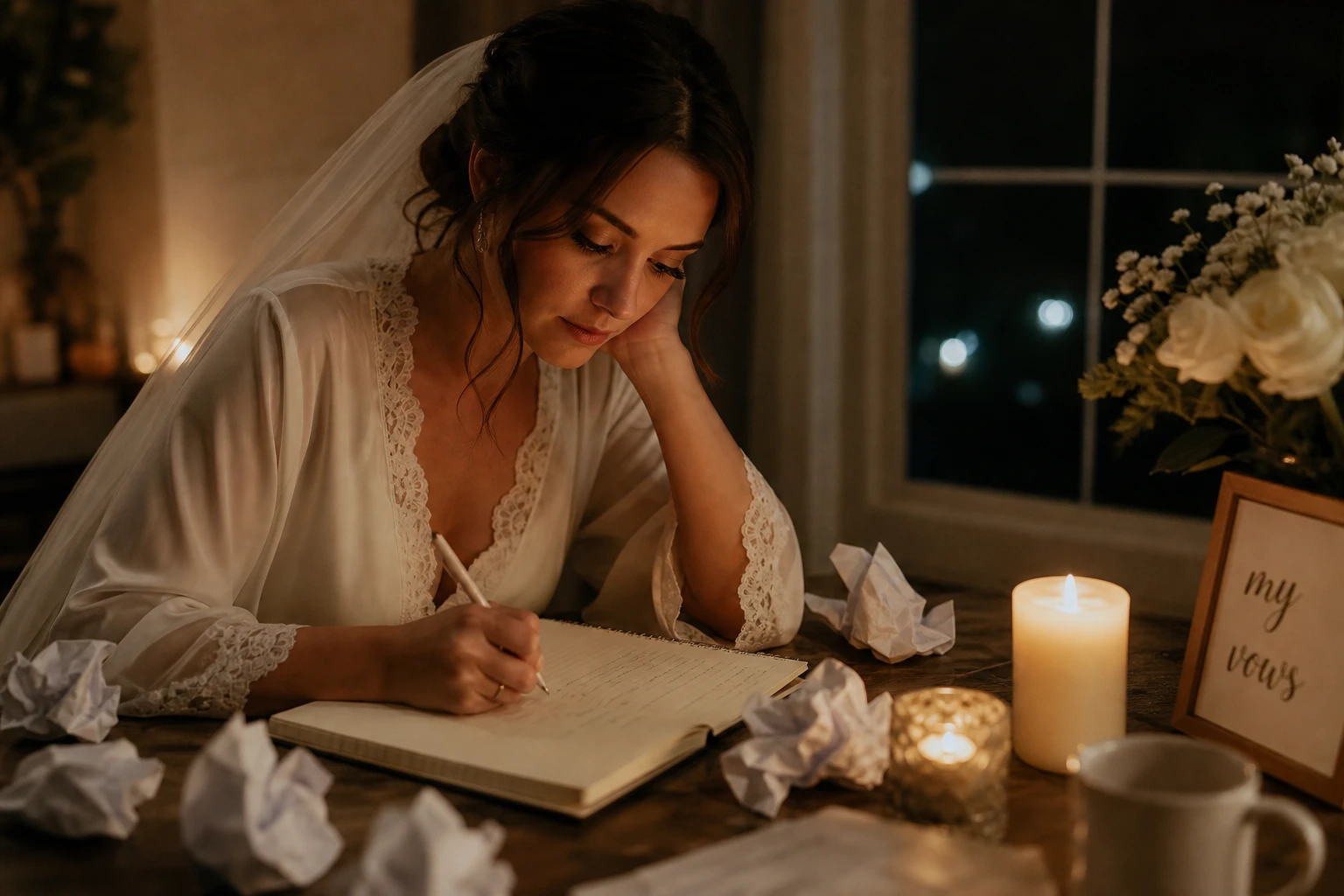
You decided to write your own vows. Now it's two weeks before the wedding and you're staring at a blank page.
This is the most common vow-writing crisis in Kenya right now — couples who know they want to say something personal and true, who genuinely mean it, but who have absolutely no idea how to get the words from their heart onto paper.
Here's the truth: writing good wedding vows is not about being a good writer. It's about being honest and specific. You don't need poetry. You need clarity. And you have everything you need — you just need a process.
This guide gives you that process, step by step.
Step 1: Understand What Your Vows Need to Do
Before you write a single word, get clear on what vows are actually for. Your wedding vows are a public promise — spoken to your partner, witnessed by your people, meant to last your entire life.
They need to do three things:
- Declare your love — not as a feeling that came over you, but as a choice you're making
- Make specific promises — what you're committing to, in concrete terms
- Cast a vision — the kind of partnership, the kind of home, the kind of life you're choosing to build together
Generic vows fail because they do all three things vaguely. "I promise to love you always" is true but empty. "I promise to sit with you in the kitchen on Sunday mornings when the week has been hard and not ask you to talk until you're ready" — that's a vow. That's a picture.
Step 2: Answer These Questions Before You Write
Set aside 30-45 minutes, get somewhere quiet, and write responses to these prompts. Don't edit yourself — just write.
About your partner:
- What is one thing about them that genuinely changed how you see the world?
- When did you know they were the person you wanted to spend your life with? What happened that day?
- What does your partner do that you've never seen anyone else do?
- What do you love that nobody else notices about them?
About your relationship:
- What has been the hardest thing you've faced together, and what did it show you?
- What does a typical Tuesday with them look like, and why does it matter?
- What does "home" mean to you now, because of them?
About the promises:
- What is the hardest promise you want to make — the one that's real and costs you something?
- What are you choosing to do differently because you're choosing them?
- What do you want them to be able to count on you for, in ten years, in thirty years?
Your answers to these questions contain your vows. Step 3 is just organizing them.
Step 3: Find Your Three Pillars
Look at what you wrote. Most of it will fall into one of three categories:
- Who they are — the qualities, the moments, the specific things that make your partner the person you're choosing
- Who you are together — the relationship itself, what it's made of, what it has survived and built
- What you're promising — the specific commitments you're making, stated plainly
Your vows work best when they move through all three: start with a moment or quality that captures who they are to you, move into what you are together, and land on the specific promises you're making.
A rough structure that works:
- Opening line — a specific moment, image, or truth that grounds everything
- A sentence or two about who they are — precise and personal, not general
- One line about what you've discovered together — optional but powerful
- Two to four specific promises — the heart of the vows
- A closing line — the vision, the "all the days of my life" note
Total length: aim for 250-400 words when read aloud. At a relaxed pace, that's roughly 2-3 minutes. Long enough to be meaningful; short enough that you don't lose your guests (or your composure).
Step 4: Write the First Draft Without Stopping
Take your three pillars and your structure and write straight through. Do not stop to edit. Do not re-read mid-paragraph. Just write.
Use the language you actually use. If you call your partner "babe" or "mpenzi wangu," those are real. If you're funny together, let a touch of that show. If your faith is central to your relationship, name it. Authenticity is the whole point.
Your first draft will be too long and not quite right. That is completely normal and expected. You're not trying to get it right on the first pass — you're trying to get it out.
Step 5: Read It Out Loud
This is the most important step that most people skip.
Print your draft (or read from your phone) and read it out loud, alone, in a room. Listen for:
- Anything that sounds like it was written, not spoken. Formal sentence constructions ("I hereby affirm") or phrases you'd never actually say. Cut them.
- Anything too vague to be real. "I'll always be there for you" — be there how? Cut it or make it specific.
- Anything that makes you cry or laugh. Those are the lines that matter. Keep them and build around them.
- The length. Time yourself. Adjust accordingly.
Read it out loud at least three times before you consider it done.
Step 6: Get It to Final Form
Once you're happy with the content, make two practical decisions:
Will you memorize it or read it? Most couples read their vows from a card. This is completely fine — there is nothing wrong with it. If you choose to read, write or print them in a large, clear font so you can glance down without squinting. If you choose to memorize, still bring a card as backup.
How will you manage emotion? Most people cry. Practice pausing. It is okay to stop, breathe, and collect yourself. Your guests will wait. They want you to finish.
A Note on Coordination
Decide with your partner: will you share your vows in advance or keep them private until the ceremony?
Sharing them in advance allows you to check for unintentional imbalance (one of you wrote two paragraphs, the other wrote nine), and to remove any accidental overlap (you both planned to use the same metaphor). It also removes some of the surprise — which some couples find actually helps with nerves.
Keeping them private preserves the emotional impact of hearing them for the first time in the moment. Most couples who do this agree to match roughly in length.
Either approach works. Decide together.
Common Mistakes to Avoid
Heading into the ceremony, avoid these:
- Starting with "So..." or "Um..." — Begin with a strong, clear line
- Listing every quality your partner has — Pick two or three specific ones and go deep, don't go wide
- Making jokes that need explanation — If you're going to be funny, keep it brief and obvious
- Promising things you can't actually control — Don't vow to "always make you happy." Promise your effort, your presence, your faithfulness — things within your power
For more on what Kenyan couples most commonly get wrong with their vows — and how to avoid it — see our article on wedding vow mistakes to avoid.
If you're incorporating Swahili into your vows, see our guide to bilingual wedding vows in English and Swahili for templates and guidance.
You Have More Than Enough
You are marrying someone specific. You have a specific history with them, specific memories, specific things about them that nobody else sees. That specificity is the raw material of great vows.
You don't need better words. You need to trust the ones that are already true.
Tell your love story where everyone can read it
Add your story to your Harusi Hub wedding website — so your guests arrive already knowing how you got here, and what today means.
Create Your Free Wedding Website